Saturday, July 6, 2013

Interesting Facts and Information About Vincent Van Gogh

Not many artists inspire more awe and mystery than the legendary Vincent Willem Van Gogh (1853 – 1890.) Most people know him as a social outcast who cut off part of his own ear, painted some masterpieces and then died from a mysterious gunshot wound that (or may not) have been self-inflicted. But many facts surrounding Vincent’s life are even stranger than that whole ear thing.

Why He Signed his Paintings "Vincent"
Van Gogh signed most of his major paintings with his first name. Usually, an artist signed with initials or the last name. He was a Dutchman with a name easy for non-Dutch to spell but difficult to pronounce. "Van Gogh" is not pronounced "van go" or "van goff" but a sound difficult to reproduce in English spelling. The best approximation is "van hawkgh" to sound similarly (but not exactly) to "cough."

He was perhaps tired of hearing foreigners mangle his last name and so preferred to be called by the more easily pronounced Vincent. He also had a considerable talent for ticking off his family members, so he may have started signing "Vincent" in order to distance himself from the whole Van Gogh clan.

He Wasn't the Biggest Failure in the Family

Vincent was definitely the black sheep of his family, but he was nothing compared to his first cousin Hendrik Jacob Eerligh Van Gogh, the son of Vincent's uncle, Rear Admiral Johannes (Jan) Van Gogh (1817 - 1885). Uncle Jan made a fortune in his career and watched it all wash away when his son (Vincent's cousin) stole it all and escaped to America, where he would die just one year after his father. He is buried in Portland, Oregon.

Not much is known about Hendrik except that he was diagnosed with epilepsy and apparently drank a great deal. The only treatment for epilepsy back then was to stick the person in an insane asylum. No wonder he ran off to another continent entirely.

His Parents had Another Vincent Willem Van Gogh

Exactly one year before Vincent was born, a son was born to his parents and named Vincent Willem Van Gogh. Unfortunately, he was stillborn. The tiny body was buried at the church where Vincent's father worked. Every time Vincent went to church, he saw a grave with his name and birth date on it.

Although this would seem to be a significant detail in a man's life, it was basically ignored by Vincent and his family. The 1850s did have high death rates for babies and so reusing a good name perhaps made sense at the time.


More of my posts about Vincent's life:

Did Van Gogh Have Syphilis?
Did Van Gogh Like People?
Van Gogh's First Drawings

Saturday, June 1, 2013

Van Gogh -- the Horse

For many years, especially when I was deeply into the model horse hobby, I discovered that Van Gogh is a common name bestowed upon real horses (as well as model horses.)  I admit to once naming a model horse Van Gogh (because one of the ears broke off.)  I've never had a real horse or pony and so I never had the chance to think up a name for a real (as opposed to model) equine.

When I lived in England, there were many thoroughbred race horses named after classical composers or painters.  One horse I actually won some money on was named George Stubbs (an exceedingly appropriate name for that elegant thoroughbred.)  I also remember a racehorse named Van Gogh but I cannot seem to find any information on him.  I did find information on a Miss Van Gogh (2005 bay filly by Vindication and out of Heartwood) and a photo of another horse named Van Gogh on a blog about off-the-track thoroughbreds.

But I did discover a non-thoroughbred named Van Gogh (pictured).  He's a big bay warmblood stud, son of Numero Uno.  Both of his ears are intact, although he needs to wear earmuffs when performing before a crowd.  He's approved as a registered stallion in four breeds (KWPN, Oldenburg, Hanoverian, Italian U.N.I.R.E.).  He lives in Europe but does not need to actually visit the mares he inseminates.  Non-Europeans can buy his frozen semen from Bellingham, Washington for $275 and $375 if you live in Canada.

I can't help but think Vincent would have got a kick over this.  He also seemed to like horses and wrote about his sympathy for cab horses.  In one letter (catalogued as letter #582) to brother Theo, Vincent wrote, "In Paris, one is always suffering, like a cab horse ..."

Vincent also included horses in his art, but rarely.  Since he was so annoyed at Anton Mauve (well known for his horse and livestock paintings) Vincent may have purposefully excluded horses just because Mauve would include them in his works.  If Vincent had horse ears, they'd spend most of the time pinned to the sides of his head.

Often the close-up horses seem somehow bedraggled while ones in the distance pulling carts tend to seem jaunty with their heads, ears and tails up.  For more about the horses in Vincent's art, check out Equinest's The Horses of Van Gogh.  Eventually, I'll get around to writing a more detailed article on Vincent's horses.

Wednesday, May 29, 2013

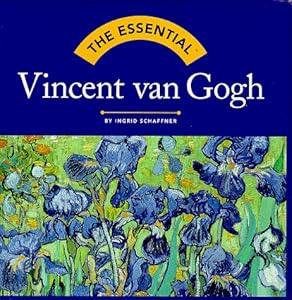
"The Essential Vincent van Gogh"; By Ingrid Schaffer: My Review

The back cover claims that you can be a Van Gogh expert in 5 minutes with The Essential Vincent Van Gogh" by Ingrid Schaffer (Harry N. Abrams; 1998.)  You won't. It also takes longer than 5 minutes to read this small hardback -- unless you decide to just look at the pictures.  You may be able to finish it while waiting in line for a new Van Gogh exhibition.

However, some of the facts in this little book are wrong.  For example, it claims that Van Gogh didn't start drawing until he was 27.  He actually started as a child.  Some of the interpretations of Vincent's major works are spot on.  It also talks a little about the debate over what painting was Van Gogh's last -- something usually passed over in other books.

This little book is aimed for tweens, teens and adults with really short attention spans.  It's littered with white space, summaries, bullet points, "sound bytes" (short quotes in large print), modern slang and exclamation marks.  It does have some great reproductions on Van Gogh's best known works, including The Starry Night, The Yellow House and Irises.

This book is one in a series on famous artists.  Other artists in the series include Andy Warhol, Jackson Pollok, Man Ray, Edward Hopper, Mary Cassatt, Henri Matisse and Claude Monet.

Friday, May 24, 2013

"Vincent Van Gogh: A Book of Postcards"; By Pomegranate: A Review

This little book is just what it says on the cover: 30 oversize postcards of color reproductions of Vincent Van Gogh paintings.  Published by Pomegranate in 1999 to cash in on the massive 1999 Van Gogh exhibition that brought out huge crowds that would put most rock stars to shame, this is about the cheapest Van Gogh art book you can get. Personally, I recommend skipping this book and saving your money for a better Van Gogh book -- even those aimed for kids.

I got my copy from my Mom, who went to the 1999 exhibition when it hit the East Coast.  Idiot me decided I didn't have enough money to go along with her.

Anyway, I've no idea why anyone would actually use the postcards in Vincent Van Gogh: A Book of Postcards.  Even if you were desperate for a postcard, there is no easy way to actually remove a postcard from the binding.  Not without an X-acto knife, anyway.

Images include the well-known (like Portrait of Dr. Gachet but mostly lesser-known works (like Madame Roulin Rocking the Cradle (Le berceuse)) and a couple of completely forgettable works (like The Drinkers.)  I guess you're supposed to keep the more popular images for yourself and send the lesser known works as postcards.

Wednesday, May 22, 2013

Painting Focus: Portrait of the Postman Joseph Roulin

Yup -- here's another article I wrote for Helium.com about a famous Van Gogh painting.  Helium comes up with it's own titles that (unfortunately) we mere writers cannot change -- even if the title contains a misspelling or factual error.  This time around, Helium states that the portraits of the postman Joseph Roulin were done in 1889.  They were actually done in 1888.  Any other errors in the text body (like the misspelling of Daumier's name) are my fault.

Please read my article at Helium about Vincent's portraits of Joseph Roulin.  Thanks!

5 More Van Gogh Parodies

'Cause Van Gogh paradies are so much fun!  If you can't afford a real Van Gogh, you can afford to download a Van Gogh parody. Enjoy.


(Yes I know about this is a mispronunciation, but it's Grumpy Cat.)


YouTube Video: 1990 South Bank "Vincent and Theo"

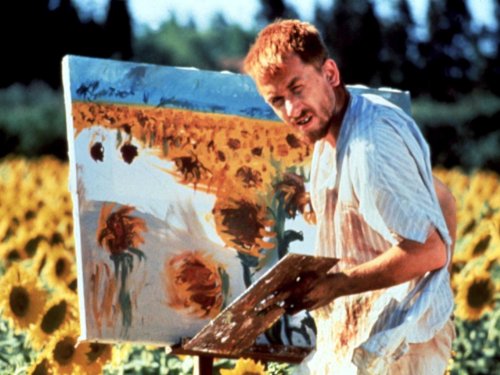
It's a shame that a series like South Bank Show in America. This is a great 1990 documentary about making of Robert Altman's film Vincent and Theo (1990), of which bits and pieces of it pop up on YouTube.  This seems to be the entire episode (which, for some reason, YouTube will not allow me to place the clip on this blog.)

It focuses on director Altman and his problems making a fictional movie about a beloved historical figure nd his long-suffering brother.  Tim Roth (pictured) puts on a killer performance as Vincent.