In case you didn't know it, 2015 is the 162nd birthday year of our man Vincent. There were many great and not-so-great celebrations of this sobering passage of time this year, but here are the best. And how did I judge them to be the best? Entirely from my biased viewpoint, of course! If you know of any other celebrations worth noting, feel free to leave info or links in the comments section.
Here we go now:
Commemorative Coin
I guess it only made "cents" that a coin would be made to celebrate Vincent. In this case, the amount is 5 Euros and 10 Euros, a denomination that did not exist during all of Vincent's short life. Actually, I cheated a little to include this on the list. The coins came out years ago, but I just found about them this year SO THERE.
Minneapolis Institute of Art's Honkin' Big Recreation of "Olive Trees"
Going to fly into the Minneapolis Airport anytime soon? Or perhaps you recently had a flight and looked out the window and thought you were losing what was left of your mind? Well, you will or may have already checked out the massive recreation of Van Gogh's Olive Trees in a field near the airport. The work was commissioned by the Minneapolis Institute of Art (MIA) and done by "earthworks artist" Stan Herd. No, I don't know what Stan heard, but it looks like you can dance to it. Wow!
Starry Night Grown in a Petri Dish
Now, scientists get a bad rap by those of an artistic employment. But scientists are highly creative individuals, as shown by members of the American Society for Microbiology. Van Gogh's big birthday coincided nicely with the first art contest put on by the society. The canvas was a petri dish (or succession of them) and the paint were different colored strains of bacteria. Now that's taking art to new levels and to new species.
The Google Doodle
Because they had to. (This originally went up in 2005.)
And a special shout out to
The Dahlia Parade in Zundert, Netherlands
In September, there was a flower parade to end all flower parades -- for Van Gogh fans, anyway. Floats a mere 62 feet long celebrating Van Gogh's works. Floats took about a year to make and were mostly made up of 50 species of dahlia flowers. The Rose Bowl got nuthin' on this. Well done, Zundert. More photos can be found here.
Showing posts with label Misc. Show all posts
Saturday, December 26, 2015
Thursday, May 14, 2015
Van Gogh in Poetry
Vincent Van Gogh is not just a great artist (oh no) but he is also considered a great metaphor for poets. (For those of you who failed English 101, a metaphor is a description that does not use "like" or "as.") In other words, metaphors are things used to describe other things. This may seem like a roundabout way of making a point, but many times the point made with a metaphor makes more of an impact than if a poet or writer just used a plain description.
Here's a short look at how Vincent Van Gogh has been used to describe other things by major poets of the twentieth century. Major to ME, anyway and hopefully major to you. This is in no way a comprehensive list.
Charles Bukowski
This much-missed American icon (and subject of the cult film Barfly) was one of the most accessible poets America ever produced. He made his point without being sappy or using references so obscure that only he himself could comprehend them. Van Gogh shows up several times in the course of Bukowski's career.
Van Gogh is the starving artist who no one understands. He's very much like Bukowski himself, only Bukowski did receive critical acclaim and some money in his debauched lifetime. Van Gogh is described as a romantic and a professional fighter. He's also sometimes a hero for Bukowski, such as in "About My Very Tortured Friend Peter."
Anne Sexton
Anne Sexton was the OTHER woman poet who committed suicide. She's best remembered, perhaps, as the inspiration for Peter Gabriel's classic song Mercy Street. She was also a very powerful and influential poet who first wrote poetry as a suggestion from her therapist. She wrote mostly about herself.
The Starry Night refers to Van Gogh's painting of the same name (the one Dan Mclean sang about.) It begins with a quote from Van Gogh's letters. It then describes Sexton's emotions when viewing the painting. It has an achingly beautiful refrain: "Oh starry starry night! This is how I want to die." You're not alone, there Anne.
The Van Gogh Poetry Challenge
While researching this article, I stumbled across the Van Gogh poetry challenge. It has some interesting work. Poetry and paintings both are stereo-typically hard to get for the average person, but I think these poems are easy to get and rewarding to read.
If you could write a poem about Van Gogh, what would you write?
Here's a short look at how Vincent Van Gogh has been used to describe other things by major poets of the twentieth century. Major to ME, anyway and hopefully major to you. This is in no way a comprehensive list.
Charles Bukowski
This much-missed American icon (and subject of the cult film Barfly) was one of the most accessible poets America ever produced. He made his point without being sappy or using references so obscure that only he himself could comprehend them. Van Gogh shows up several times in the course of Bukowski's career.
Van Gogh is the starving artist who no one understands. He's very much like Bukowski himself, only Bukowski did receive critical acclaim and some money in his debauched lifetime. Van Gogh is described as a romantic and a professional fighter. He's also sometimes a hero for Bukowski, such as in "About My Very Tortured Friend Peter."
Anne Sexton
Anne Sexton was the OTHER woman poet who committed suicide. She's best remembered, perhaps, as the inspiration for Peter Gabriel's classic song Mercy Street. She was also a very powerful and influential poet who first wrote poetry as a suggestion from her therapist. She wrote mostly about herself.
The Starry Night refers to Van Gogh's painting of the same name (the one Dan Mclean sang about.) It begins with a quote from Van Gogh's letters. It then describes Sexton's emotions when viewing the painting. It has an achingly beautiful refrain: "Oh starry starry night! This is how I want to die." You're not alone, there Anne.
The Van Gogh Poetry Challenge
While researching this article, I stumbled across the Van Gogh poetry challenge. It has some interesting work. Poetry and paintings both are stereo-typically hard to get for the average person, but I think these poems are easy to get and rewarding to read.
If you could write a poem about Van Gogh, what would you write?
Friday, October 17, 2014
Van Gogh Painting At Sotheby's May Make $50 Million
Have an extra $50 million burning a hole in your pocket? That's how much you'll need to get one of the Venus' arms of paintings, a Van Gogh looking for a buyer. Prestigious auction house Sotheby's is estimates that Still Life, Vase with Daisies and Poppies (1890) (also called Still Life: Red Poppies and Daisies) will go under the hammer anywhere from $30 million to $50 million (US).
The painting officially goes on sale November 4 at Sotheby's Impressionist and Modern Art Evening Sale. It is, unpredictably, predicted to be the sale highlight. Museums, private owners of Van Gogh's works and the companies that insure them will be more than eager to see what the final price is as this will help them re-evaluate how much their Van Gogh's are now worth.
What's so special about this painting? It's red flowers in a vase, right? The background is similar to those of the infamous Sunflowers series. This also may be one of the last paintings that Van Gogh did, according to the New York Observer. It was painted at Auvers-sur-Oise, France, possibly in June of 1890.
Let's hope that Still Life, Vase with Daisies and Poppies does not share the same fate as Portrait of Dr. Gachet which disappeared after being bought at a Christie's auction for a Japanese collector 1990. That painting's price was over $82 million. Very few Van Gogh paintings have ever been on the open market in America since the 1980's, notes The Financial Times.
Image is from the Van Gogh Gallery's excellent website.
EDIT November 5: The painting went for $61.8 million.
The painting officially goes on sale November 4 at Sotheby's Impressionist and Modern Art Evening Sale. It is, unpredictably, predicted to be the sale highlight. Museums, private owners of Van Gogh's works and the companies that insure them will be more than eager to see what the final price is as this will help them re-evaluate how much their Van Gogh's are now worth.
What's so special about this painting? It's red flowers in a vase, right? The background is similar to those of the infamous Sunflowers series. This also may be one of the last paintings that Van Gogh did, according to the New York Observer. It was painted at Auvers-sur-Oise, France, possibly in June of 1890.
Let's hope that Still Life, Vase with Daisies and Poppies does not share the same fate as Portrait of Dr. Gachet which disappeared after being bought at a Christie's auction for a Japanese collector 1990. That painting's price was over $82 million. Very few Van Gogh paintings have ever been on the open market in America since the 1980's, notes The Financial Times.
Image is from the Van Gogh Gallery's excellent website.
EDIT November 5: The painting went for $61.8 million.
Friday, October 10, 2014
Vincent Van Gogh The Musical -- Just Say No
The passion of the artist committed to finding the sacred in the common ... the suffering of an ignored genius ... the ultimate tragedy of an artist dying on the verge of international acclaim ... all of this is just a fraction of the complex portrait of the man, the myth, the legend -- Vincent Van Gogh.
And soon it will coming to you -- as a musical.
WHAT? No, sorry -- you read that right. According to the Telegraph, Vincent will premier in Amsterdam sometime in the autumn of 2015. Why 2015? Because that is the 125th anniversary of Van Gogh's death. It will be produced by a Dutchman, Albert Verlinde. The aim of the musical is to "bring Vincent van Gogh's works to life in a non-traditional way". Content is expected to focus on the decent into madness and the Ear Thing.
Non-traditional is right. Amsterdam -- you have been warned.
The Don McClean pop song was bad enough (hey -- at least that was catchy if way too fanboyish). Do we really have to suffer through a two-hour musical? Or even just the knowledge that a musical on Van Gogh exists? Only if it's a comedy, please.
The rather bemused and confused Van Gogh Museum of Amsterdam plans on holding a special exhibit that somehow has a tenuous connection with the musical. The director of the museum has been quoted in the press as saying, "It's perhaps a little odd to celebrate his death."
Just when you think pop culture can't get any worse -- it does.
And soon it will coming to you -- as a musical.
WHAT? No, sorry -- you read that right. According to the Telegraph, Vincent will premier in Amsterdam sometime in the autumn of 2015. Why 2015? Because that is the 125th anniversary of Van Gogh's death. It will be produced by a Dutchman, Albert Verlinde. The aim of the musical is to "bring Vincent van Gogh's works to life in a non-traditional way". Content is expected to focus on the decent into madness and the Ear Thing.
Non-traditional is right. Amsterdam -- you have been warned.
The Don McClean pop song was bad enough (hey -- at least that was catchy if way too fanboyish). Do we really have to suffer through a two-hour musical? Or even just the knowledge that a musical on Van Gogh exists? Only if it's a comedy, please.
The rather bemused and confused Van Gogh Museum of Amsterdam plans on holding a special exhibit that somehow has a tenuous connection with the musical. The director of the museum has been quoted in the press as saying, "It's perhaps a little odd to celebrate his death."
Just when you think pop culture can't get any worse -- it does.
Sunday, April 13, 2014
My Favorite Van Gogh Painting: Sunflowers
I've just realized that I've had this blog for over a year and have yet to write extensively about my favorite painting by Vincent Van Gogh. I will now rectify this immediately.
As this post's title suggests, my favorite Van Gogh painting is Sunflowers (Tournesols). Ah, but which Sunflowers, you ask? Van Gogh did numerous paintings featuring these gaudy flowers in different shades, vases and sometimes with other flowers. The one I like is the most famous version with a yellow-gold background, painted in 1888 and now hangs in the National Gallery in London.
Why? Well, my Mom bought a cheap framed reproduction when I was a very small child. It hung on the stairway next to the stacks of National Geographics that my family once collected (and are now long gone.) About 40 years later, after my parents' divorce, my two busted live-in relationships and God knows how many moves, it's about all that's left of my childhood. It's still owned by my Mom.
When I was 29, I had a mental breakdown and ran away to live with a busker in England. That didn't work out and I burned a lot of bridges back to America. And then one day my make-shift shelter in the woods was burnt down. The fire brigade suspected arson. I knew someone was trying to kill me and my dog. I never thought my Mom would take me in, but she did -- and took my dog in, too.
She set up a bedroom for me in the basement. There, propped against a mirror, was the Sunflowers painting. I had come home.
Below is a short news clip about two of the most famous versions from London and the Van Gogh Museum in Amsterdam of Sunflowers being shown side by side.
What is your favorite Van Gogh painting?
As this post's title suggests, my favorite Van Gogh painting is Sunflowers (Tournesols). Ah, but which Sunflowers, you ask? Van Gogh did numerous paintings featuring these gaudy flowers in different shades, vases and sometimes with other flowers. The one I like is the most famous version with a yellow-gold background, painted in 1888 and now hangs in the National Gallery in London.
Why? Well, my Mom bought a cheap framed reproduction when I was a very small child. It hung on the stairway next to the stacks of National Geographics that my family once collected (and are now long gone.) About 40 years later, after my parents' divorce, my two busted live-in relationships and God knows how many moves, it's about all that's left of my childhood. It's still owned by my Mom.
When I was 29, I had a mental breakdown and ran away to live with a busker in England. That didn't work out and I burned a lot of bridges back to America. And then one day my make-shift shelter in the woods was burnt down. The fire brigade suspected arson. I knew someone was trying to kill me and my dog. I never thought my Mom would take me in, but she did -- and took my dog in, too.
She set up a bedroom for me in the basement. There, propped against a mirror, was the Sunflowers painting. I had come home.
Below is a short news clip about two of the most famous versions from London and the Van Gogh Museum in Amsterdam of Sunflowers being shown side by side.
What is your favorite Van Gogh painting?
Wednesday, April 9, 2014
Orangutan Being Called the Next Van Gogh
Let me clear. I have nothing against orangutans. I like orangutans. But I have a real hard time taking seriously anyone who compares an orangutan's paintings to a Van Gogh. That's what ABC News is saying on their website.
Rudi Valentino, the 36 year old male orangutan lives at the Houston Zoo. It must be kinda dull at the zoo, because 10 years ago, Rudi took up a new hobby -- painting. He paints on any surface he can get a hold of. Van Gogh's painting career only lasted ten years.
According to Rudi's keepers, his favorite color is pink and that he has "an artistic temperament."
Rudi's works are being auctioned off tomorrow, April 10, in order to benefit the zoo. Rudi's not the only animal artist in the auction. There are also works by an elephant, a clouded leopard and a pig. I have seen some of Rudi's work (pictured) and I have to say I'm not impressed. Sure, he still paints better than I do, but he's not quite in the Van Gogh department.
If Rudi is supposedly like Van Gogh, then his keepers need to keep him away from booze and whores is all I'm saying.
Rudi Valentino, the 36 year old male orangutan lives at the Houston Zoo. It must be kinda dull at the zoo, because 10 years ago, Rudi took up a new hobby -- painting. He paints on any surface he can get a hold of. Van Gogh's painting career only lasted ten years.
According to Rudi's keepers, his favorite color is pink and that he has "an artistic temperament."
Rudi's works are being auctioned off tomorrow, April 10, in order to benefit the zoo. Rudi's not the only animal artist in the auction. There are also works by an elephant, a clouded leopard and a pig. I have seen some of Rudi's work (pictured) and I have to say I'm not impressed. Sure, he still paints better than I do, but he's not quite in the Van Gogh department.
If Rudi is supposedly like Van Gogh, then his keepers need to keep him away from booze and whores is all I'm saying.
Wednesday, April 2, 2014
Scientists Use Van Gogh Paintings to Look at History of Climate
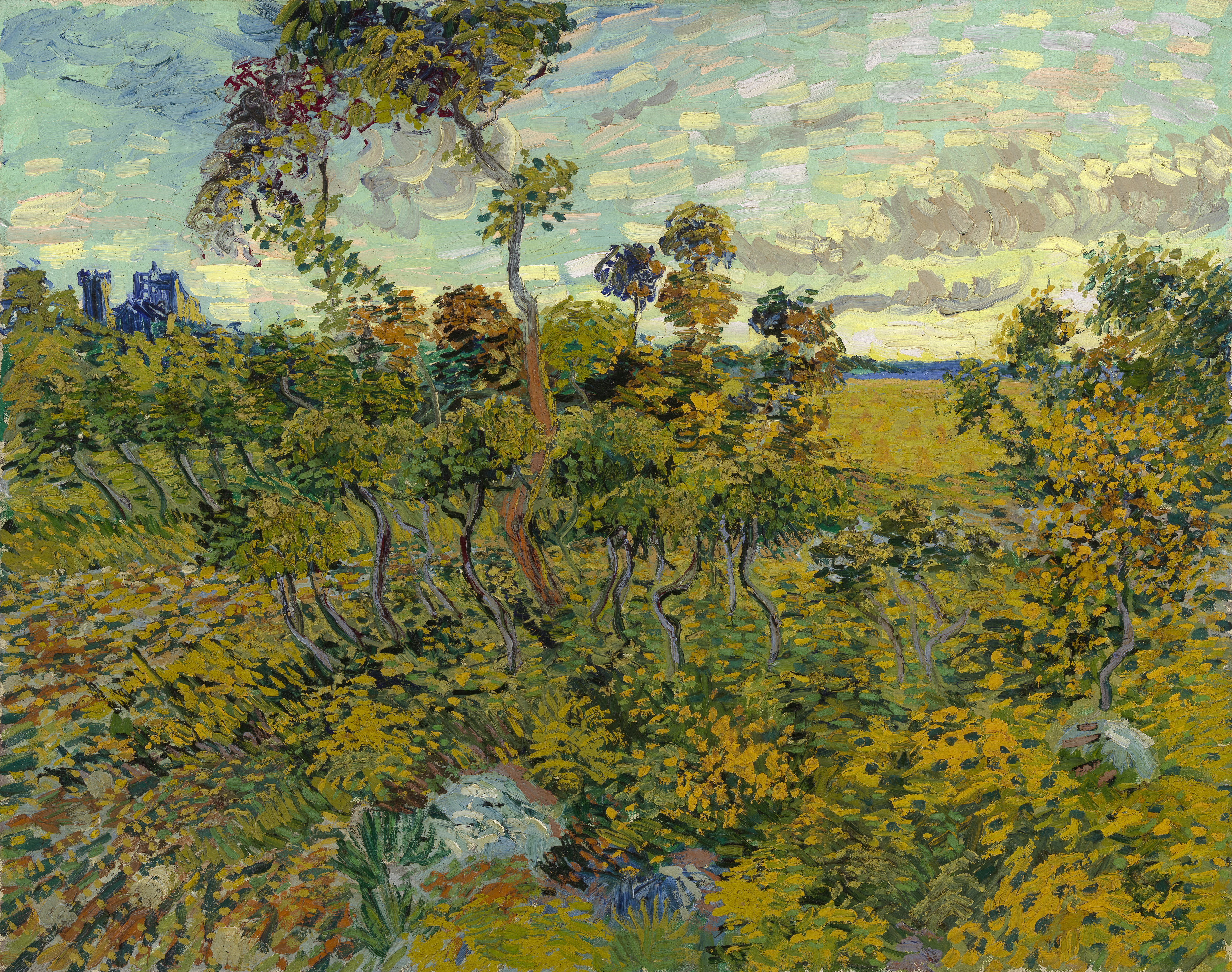
Vincent Van Gogh doesn't just matter to art lovers, but also to scientists. Some Greek and German scientists have looked at hundreds of paintings and photos from 1500, including Van Gogh's recently discovered Sunset at Montmajour (pictured) in order to see what the skies used to look like. Their article was published in the journal Atmospheric Chemistry and Physics.
Why bother looking at paintings? Well, they didn't have photographs (let alone color photographs) back in 1500. One subject painters seemed to love was how the sky looked like after a volcanic explosion. By comparing the paintings to color photographs of polluted skies and skies after volcanic explosions, scientists hope to get a better picture of our planet's climactic history.
This isn't the first time this group has used paintings to help figure out the history of the air. They previously published a large study in the same journal back in 2007. They also commissioned a contemporary artist to paint sunsets after a dust storm in 2010 on the island of Hydra. Paintings by JMW Turner were also used in the study.
According to the study's authors, "Because of the large number of paintings studied, we tentatively propose the conclusion that regardless of the school, red-to-green ratios from great masters can provide independent proxy AODs [Aerosol Optical Depth] that correlate with widely accepted proxies and with independent measurements."
Why bother looking at paintings? Well, they didn't have photographs (let alone color photographs) back in 1500. One subject painters seemed to love was how the sky looked like after a volcanic explosion. By comparing the paintings to color photographs of polluted skies and skies after volcanic explosions, scientists hope to get a better picture of our planet's climactic history.
This isn't the first time this group has used paintings to help figure out the history of the air. They previously published a large study in the same journal back in 2007. They also commissioned a contemporary artist to paint sunsets after a dust storm in 2010 on the island of Hydra. Paintings by JMW Turner were also used in the study.
According to the study's authors, "Because of the large number of paintings studied, we tentatively propose the conclusion that regardless of the school, red-to-green ratios from great masters can provide independent proxy AODs [Aerosol Optical Depth] that correlate with widely accepted proxies and with independent measurements."
Tuesday, March 4, 2014
Van Gogh, 4 Other Artists Immortalized in Food in Art Fund Competition
Let me begin by saying that I used to be homeless. Food was a sacred issue. To find any was rapture and to waste any was an unforgivable sin. You could play with your food -- but only if nothing was wasted and everything was eaten before it began to rot.
So forgive me if I cannot get into the food art fad, which got a huge shot of publicity in February when the prestigious Time magazine did a feature on 5 artistic masterpieces recreated with food, including Vincent Van Gogh's Self Portrait with a Bandaged Ear turned into a vertical ploughman's lunch (pictured, left.) The frame is made up of sliced bead and French loaf, the eyes peppercorns, the coat button a pickle slice, the green bits lettuce and the bandage a smear of brie. Somewhere there are gherkins, pickled onions and yellow cheese.
Another interesting creation was a Rice Crispie Treat splattered with icing to mimic a Jackson Pollack painting. Also there is a recreation of Damien Hurst's Skull which defies explanation, although apparently almonds played a part in it. See even more on Art Fund's Instagram page, Facebook page or on Twitter using the #ediblemasterpieces.
These creations were done to raise money for the UK non-profit Art Fund as part of the Edible Masterpieces Project, a competition which goes in until 30 June, 2014. This uses all kinds of fundraising events to give money to UK's art galleries and museums so they will not close. Now that I can sink my teeth into.
Image is from Slate, which got it from Art Fund. I'm not sure if the image is copyrighted. (Sorry!)
So forgive me if I cannot get into the food art fad, which got a huge shot of publicity in February when the prestigious Time magazine did a feature on 5 artistic masterpieces recreated with food, including Vincent Van Gogh's Self Portrait with a Bandaged Ear turned into a vertical ploughman's lunch (pictured, left.) The frame is made up of sliced bead and French loaf, the eyes peppercorns, the coat button a pickle slice, the green bits lettuce and the bandage a smear of brie. Somewhere there are gherkins, pickled onions and yellow cheese.
Another interesting creation was a Rice Crispie Treat splattered with icing to mimic a Jackson Pollack painting. Also there is a recreation of Damien Hurst's Skull which defies explanation, although apparently almonds played a part in it. See even more on Art Fund's Instagram page, Facebook page or on Twitter using the #ediblemasterpieces.
These creations were done to raise money for the UK non-profit Art Fund as part of the Edible Masterpieces Project, a competition which goes in until 30 June, 2014. This uses all kinds of fundraising events to give money to UK's art galleries and museums so they will not close. Now that I can sink my teeth into.
Image is from Slate, which got it from Art Fund. I'm not sure if the image is copyrighted. (Sorry!)
Wednesday, February 19, 2014
Little Seen Van Gogh Painting Fetches 16.9 Million Pounds at Auction
A Sotheby's auction in early February reached a record amount in part due to a Van Gogh painting which fetched 16.9 million pounds, reports Bloomberg. The Van Gogh was the second most expensive painting of the London auction, which raked in a grand total of 169.5 million pounds (US $266.8 million.)
The first most expensive painting of the evening was "Boulevard Montmartre" by Camille Pissarro. It was estimated to go at 10 million pounds but when the hammer fell the price was 19 million pounds. About 60% of the auction pieces went for prices higher than Sotheby's estimate, which indicates that the world art market is coming back strong.
Van Gogh's "The Man Is At Sea (L’Homme Est en Mer)" was estimated to bring in a mere 8 million pounds. This is the canvas' second time at Sotheby's. In 1989, it was sold in the New York branch of Sotheby's for a piddling $7.15 million. Things get a little muddied as to the painting's history after 1989. According to Sotheby's, it was bought by an anonymous art consigner in 1993 and sold to Holocaust survivor and art dealer Jan Krugier. Krugier died in 2008 but his extensive art collection did not go on sale until this year.
Van Gogh painted the woman and baby at home waiting for Daddy in front of the hearth while he was an inmate at the asylum in Saint-Remy, France in 1889, about a year before the artist's death. Van Gogh's paintings were considered worthless in his lifetime. The first owner of the painting was Dr. Paul Gachet, Vincent's final therapist and one of his models. It has had several wealthy owners after the good doctor's family sold the painting in the early 1900s. It was last exhibited publicly in Paris in 1905.
The first most expensive painting of the evening was "Boulevard Montmartre" by Camille Pissarro. It was estimated to go at 10 million pounds but when the hammer fell the price was 19 million pounds. About 60% of the auction pieces went for prices higher than Sotheby's estimate, which indicates that the world art market is coming back strong.
Van Gogh's "The Man Is At Sea (L’Homme Est en Mer)" was estimated to bring in a mere 8 million pounds. This is the canvas' second time at Sotheby's. In 1989, it was sold in the New York branch of Sotheby's for a piddling $7.15 million. Things get a little muddied as to the painting's history after 1989. According to Sotheby's, it was bought by an anonymous art consigner in 1993 and sold to Holocaust survivor and art dealer Jan Krugier. Krugier died in 2008 but his extensive art collection did not go on sale until this year.
Van Gogh painted the woman and baby at home waiting for Daddy in front of the hearth while he was an inmate at the asylum in Saint-Remy, France in 1889, about a year before the artist's death. Van Gogh's paintings were considered worthless in his lifetime. The first owner of the painting was Dr. Paul Gachet, Vincent's final therapist and one of his models. It has had several wealthy owners after the good doctor's family sold the painting in the early 1900s. It was last exhibited publicly in Paris in 1905.
Friday, January 24, 2014
A Pair of Van Gogh's Sunfllowers Shown Together in London
Going to be in London? You lucky dogs. You'll get an opportunity to see a sight which was last viewed 65 years ago -- when two versions of Vincent Van Gogh's infamous sunflower paintings were hung side by side. The display will last for three months only until April. Remember -- admission to The National Gallery is free. Compare that to the cost of seeing a Van Gogh in an American museum, where charges rom $25 to $35 per person are not uncommon.
One version is owned by the National Gallery in London. It was bought in 1924 from the Van Gogh family for a whopping 24 million pounds sterling. The other is owed by the Van Gogh Museum in Amsterdam. They are now displayed in Room 46 of the National Gallery.
There are several versions of Van Gogh's sunflower paintings. My personal favorite is the one I have actually travelled to see at the Philadelphia Museum of Art. Sadly, one version was destroyed during World War II, although photos of it apparently still exist. Because of their value, the chances of all existing versions being brought together in one museum are next to impossible. The sunflowers in Philly, for example, is one of the cash cows for that museum and so it could never part with it.
Vincent once wrote that his sunflowers were really self-portraits. Perhaps he was in a more positive frame of mind when he wrote that. In his career, Vincent painted sunflowers in all their stages from seeds to dried dead flowers. When Paul Gauguin painted his portrait of Vincent, he chose one of Vincent painting sunflowers. Vincent reportedly said of it, "It is a portrait of me, but a portrait of me gone mad."
One version is owned by the National Gallery in London. It was bought in 1924 from the Van Gogh family for a whopping 24 million pounds sterling. The other is owed by the Van Gogh Museum in Amsterdam. They are now displayed in Room 46 of the National Gallery.
There are several versions of Van Gogh's sunflower paintings. My personal favorite is the one I have actually travelled to see at the Philadelphia Museum of Art. Sadly, one version was destroyed during World War II, although photos of it apparently still exist. Because of their value, the chances of all existing versions being brought together in one museum are next to impossible. The sunflowers in Philly, for example, is one of the cash cows for that museum and so it could never part with it.
Vincent once wrote that his sunflowers were really self-portraits. Perhaps he was in a more positive frame of mind when he wrote that. In his career, Vincent painted sunflowers in all their stages from seeds to dried dead flowers. When Paul Gauguin painted his portrait of Vincent, he chose one of Vincent painting sunflowers. Vincent reportedly said of it, "It is a portrait of me, but a portrait of me gone mad."
Saturday, December 28, 2013
Rarely Seen Van Gogh Painting on Display in Washington
Can you get to Washington, D.C.? If you can, give yourself a big treat and check out the National Gallery. In particular, you want to look for a painting that hasn't been seen in public since 1966 -- Vincent Van Gogh's “Green Wheat Fields, Auvers,” (1890.) The Gallery also has eight other Van Goghs and lots of other visual goodies as well.
Although a calmer, less "busy" work than Van Gogh's best known paintings, this is still a subtly complex and pleasingly bright work. Although some critics say that it reflected Van Gogh's more calmer state of mind, I have to disagree. Although the fields of young wheat are happy and lively, the clouds above are not. They are in the same swirling, turbulent patterns as seen in works like "The Starry Night."
So, where was this painting from 1966? In the home of superrich snob Paul Mellon. Mellon died in 1980 and his wife in 1999, but his family clung onto the painting since then. Hung over the fireplace. The Mellons owned it since 1955 and loaned it to a museum once in 1966. Before that, it was last shown in 1912 in Cologne, Germany. The painting will now have a permanent new home where it belongs -- for the public to appreciate. The chances of the painting being loaned to other museums around the world is possible, but no plans have been announced.
Although a calmer, less "busy" work than Van Gogh's best known paintings, this is still a subtly complex and pleasingly bright work. Although some critics say that it reflected Van Gogh's more calmer state of mind, I have to disagree. Although the fields of young wheat are happy and lively, the clouds above are not. They are in the same swirling, turbulent patterns as seen in works like "The Starry Night."
So, where was this painting from 1966? In the home of superrich snob Paul Mellon. Mellon died in 1980 and his wife in 1999, but his family clung onto the painting since then. Hung over the fireplace. The Mellons owned it since 1955 and loaned it to a museum once in 1966. Before that, it was last shown in 1912 in Cologne, Germany. The painting will now have a permanent new home where it belongs -- for the public to appreciate. The chances of the painting being loaned to other museums around the world is possible, but no plans have been announced.
Thursday, October 31, 2013
Happy Halloween From Why Van Gogh Matters
Halloween was not celebrated during Vincent Van Gogh's lifetime. It's more of a modern phenomenon. However, if it was, I think that he'd really have gotten into it. His Skull of a Skeleton with Burning Cigarette (1886) displays the macabre side of his sense of humor.
Van Gogh might also be amazed by the Halloween costume sported by Damon Lucas (I think that's who this is. If I'm wrong, feel free to connect me.) Huffington Post proclaimed this costume of Van Gogh with Starry Night-like swirls as "officially wins Halloween."
I almost wish I was a redhead (and a hell of a lot thinner) in order to pull of a somewhat convincing Van Gogh costume. Check out this one praised by MSN Now for Halloween 2012.
I'd like to put a bandage over one ear, though, to really get into the Van Gogh vibe. I suppose I could suck on a candy cigarette, too or sip a green liquid out of a bottle labeled ABSINTHE. Let's see if anyone figures that out.
No matter what you do for Halloween, have a good one!
Van Gogh might also be amazed by the Halloween costume sported by Damon Lucas (I think that's who this is. If I'm wrong, feel free to connect me.) Huffington Post proclaimed this costume of Van Gogh with Starry Night-like swirls as "officially wins Halloween."
I almost wish I was a redhead (and a hell of a lot thinner) in order to pull of a somewhat convincing Van Gogh costume. Check out this one praised by MSN Now for Halloween 2012.
I'd like to put a bandage over one ear, though, to really get into the Van Gogh vibe. I suppose I could suck on a candy cigarette, too or sip a green liquid out of a bottle labeled ABSINTHE. Let's see if anyone figures that out.
No matter what you do for Halloween, have a good one!
Tuesday, September 17, 2013
New Van Gogh Painting Discovered (Sorta)
Earlier this month, art experts from the Van Gogh Museum in Amsterdam announced that a painting stored in an attic for 80 years is a genuine Van Gogh. 80 years ago, a Norwegian collector bought it thinking that it was genuine and was bitterly disappointed when it was declared a fake. When it was bought a few years ago by an anonymous family, they had the painting reassessed. They waited two years for a final report.
Why is it now considered genuine? Because researchers unearthed two newspaper articles that article mentioned this painting, "Sunset at Montmajour" The first article was a review of an Amsterdam art exhibit from 1892. The second was a review from an art exhibit in the Netherlands in 1901. It was then that the painting disappeared.
Another reason is that we can do something that we couldn't do 80 years ago -- we can chemically analyze pigments from one painting to see if it matches another. Pigments from "Sunset at Montmajour" were a match to many other known Van Gogh paintings at the Van Gogh Museum in Amsterdam. Experts can also X-ray the canvas to see if it matched other Van Gogh canvases.
The painting is not a masterpiece by a long stretch. When I first saw it, I promptly forgot what it looked like ten minutes later. That may be more of a criticism of my memory than this particular Van Gogh painting, but even the art critic of the Guardian was not impressed, who wrote that "even great artists have bad days." (Owie.)
Some Doctor Who fans love it because the buildings in the top left corner look remarkably like the good Doctor's TARDIS.
There are numerous artworks by Van Gogh that are missing. There are also artworks mentioned in his letters that do not seem to match the works known to exist or has existed. "Sunset at Montmajour" was such a painting. According to a letter from Van Gogh to his long-suffering brother Theo, he painted this on July 4, 1888.
Why is it now considered genuine? Because researchers unearthed two newspaper articles that article mentioned this painting, "Sunset at Montmajour" The first article was a review of an Amsterdam art exhibit from 1892. The second was a review from an art exhibit in the Netherlands in 1901. It was then that the painting disappeared.
Another reason is that we can do something that we couldn't do 80 years ago -- we can chemically analyze pigments from one painting to see if it matches another. Pigments from "Sunset at Montmajour" were a match to many other known Van Gogh paintings at the Van Gogh Museum in Amsterdam. Experts can also X-ray the canvas to see if it matched other Van Gogh canvases.
The painting is not a masterpiece by a long stretch. When I first saw it, I promptly forgot what it looked like ten minutes later. That may be more of a criticism of my memory than this particular Van Gogh painting, but even the art critic of the Guardian was not impressed, who wrote that "even great artists have bad days." (Owie.)
Some Doctor Who fans love it because the buildings in the top left corner look remarkably like the good Doctor's TARDIS.
There are numerous artworks by Van Gogh that are missing. There are also artworks mentioned in his letters that do not seem to match the works known to exist or has existed. "Sunset at Montmajour" was such a painting. According to a letter from Van Gogh to his long-suffering brother Theo, he painted this on July 4, 1888.
Monday, September 16, 2013
New Van Gogh Movie in the Works
As Sherlock Holmes once said in A Study in Scarlet, "There's nothing new under the sun. It has all been done before."
Another bio-pic of Vincent Van Gogh is currently in the works, according to The Hollywood Reporter. Filming is set to begin in 2014 with a tentative release date of 2015. Rutger Hauer (best known for playing a homicidal replicant in Blade Runner) has reportedly signed on as executive producer. The tentative title is Vincent. It is planned to be an English-language film. It's planned to be shot in several European locations including France, the Netherlands and England.
Despite a proliferation of stage shows, documentaries (like the one pictured) and telemovies, there have been few English language films to hit the screen. The last I can think of is Vincent and Theo (1990) directed by Robert Altman. That movie focused on the last five years or so of his life, while this movie is apparently going to cover Vincent's entire life.
The movie is to tie in with the 125th anniversary of Vincent's tragic death in 1890. So far, an estimated five years has gone into researching the movie.
Now that we've read the plans for the movie, let's see what the final result turns out to be.
Our Vincent would have loved that his life generated so many movies. He was so constantly viewed as a failure that anyone highlighting his life would have boggled his mind (but in a good way.) Then again, motion pictures as we know them -- even silent films -- first appeared after Vincent's death. The only "films" were on phenakistoscope discs that Vincent probably never got to see because that would have cost money.
Another bio-pic of Vincent Van Gogh is currently in the works, according to The Hollywood Reporter. Filming is set to begin in 2014 with a tentative release date of 2015. Rutger Hauer (best known for playing a homicidal replicant in Blade Runner) has reportedly signed on as executive producer. The tentative title is Vincent. It is planned to be an English-language film. It's planned to be shot in several European locations including France, the Netherlands and England.
Despite a proliferation of stage shows, documentaries (like the one pictured) and telemovies, there have been few English language films to hit the screen. The last I can think of is Vincent and Theo (1990) directed by Robert Altman. That movie focused on the last five years or so of his life, while this movie is apparently going to cover Vincent's entire life.
The movie is to tie in with the 125th anniversary of Vincent's tragic death in 1890. So far, an estimated five years has gone into researching the movie.
Now that we've read the plans for the movie, let's see what the final result turns out to be.
Our Vincent would have loved that his life generated so many movies. He was so constantly viewed as a failure that anyone highlighting his life would have boggled his mind (but in a good way.) Then again, motion pictures as we know them -- even silent films -- first appeared after Vincent's death. The only "films" were on phenakistoscope discs that Vincent probably never got to see because that would have cost money.
Saturday, July 6, 2013
Why Is Van Gogh Considered Such a Great Artist?
Very few people are indifferent to the art of Vincent Van Gogh (1853 - 1890.) Usually they either love it or hate it. Even during Vincent's brief lifetime, the critics were at work. One Spanish artist, visiting the inn where Vincent happened to live, looked at one of Vincent's canvasses and exclaimed, "Who is the pig that did that?" Modern critics, art lovers and casual observers have been tearing Van Gogh's work apart ever since.
What Does Life Have to do With It?
One argument critics use is the "his life was better than his art" theory. Vincent's life story was so dramatic and so tragic that it acts as a rosy-tinted filter for people looking at his work. Personally, I think that argument doesn't hold water. There have been many MANY artists that have lead tragic lives or committed suicide and none of them are as popular as Van Gogh. When you get right down to it, great art communicates more powerfully than great biographies.
Not From Just One School
Art was at a big crossroads during Vincent's life. It was moving from realism to Impressionism and then to modern art. In between were short-lived art movements like Pointillism (painting in a series of dots) and Symbolism, where the subject matter was strictly from the artist's imagination (think Paul Gauguin at his most freaky.) Vincent managed to blend the best elements of these schools without degenerating into total chaos.
Original Interpretations
What is art? One definition is "to hold a mirror up to the universe." The artist is the mirror. Van Gogh painted in a way that only he could do. He wanted to paint feelings as well as what was actually in front of him. Even when he copied other painter's works, he injected different color schemes and other subtle differences so that they are unmistakably from Van Gogh's hand. Before Van Gogh, it was very unusual for an artist to put any of his inner world into a work. If an artist wanted to put himself in the painting, he would just paint his face in there somewhere.
Ahead of His Time
There was nobody painting quite like Van Gogh in the last five years of his life. Although Van Gogh tried many styles in the ten years he spent as an artist, by 1888 he had developed his own colorfully intense style. This intensity and radical reinterpretations of the visible world greatly inspired the generations of artists that lived long after Van Gogh.
You Try and Paint Like Him, Sunshine
Think Van Gogh ain't so great? You try to paint like him. Don't copy the paintings exactly -- just paint something like him. You'll find it's an incredibly hard exercise. This is when it will finally hit home what a great artist Van Gogh was.
What Does Life Have to do With It?
One argument critics use is the "his life was better than his art" theory. Vincent's life story was so dramatic and so tragic that it acts as a rosy-tinted filter for people looking at his work. Personally, I think that argument doesn't hold water. There have been many MANY artists that have lead tragic lives or committed suicide and none of them are as popular as Van Gogh. When you get right down to it, great art communicates more powerfully than great biographies.
Not From Just One School
Art was at a big crossroads during Vincent's life. It was moving from realism to Impressionism and then to modern art. In between were short-lived art movements like Pointillism (painting in a series of dots) and Symbolism, where the subject matter was strictly from the artist's imagination (think Paul Gauguin at his most freaky.) Vincent managed to blend the best elements of these schools without degenerating into total chaos.
Original Interpretations
What is art? One definition is "to hold a mirror up to the universe." The artist is the mirror. Van Gogh painted in a way that only he could do. He wanted to paint feelings as well as what was actually in front of him. Even when he copied other painter's works, he injected different color schemes and other subtle differences so that they are unmistakably from Van Gogh's hand. Before Van Gogh, it was very unusual for an artist to put any of his inner world into a work. If an artist wanted to put himself in the painting, he would just paint his face in there somewhere.
Ahead of His Time
There was nobody painting quite like Van Gogh in the last five years of his life. Although Van Gogh tried many styles in the ten years he spent as an artist, by 1888 he had developed his own colorfully intense style. This intensity and radical reinterpretations of the visible world greatly inspired the generations of artists that lived long after Van Gogh.
You Try and Paint Like Him, Sunshine
Think Van Gogh ain't so great? You try to paint like him. Don't copy the paintings exactly -- just paint something like him. You'll find it's an incredibly hard exercise. This is when it will finally hit home what a great artist Van Gogh was.
Van Gogh -- the Drink
Van Gogh did a lot of drinking in his day. That was just about all anyone had to do in Vincent's time and financial situation. It is with no sense of surprise that I've discovered many alcoholic beverages named after Vincent. He probably would have liked them.
For a fancy drink, you can do no worse than a Van Gogh's Rocket, created by Los Angeles bistro Church & State. It's made up with the modern wimpy version of Vincent's favorite drink, absinthe, vodka, Lillet Blanc aperitif wine, lemon juice, honey syrup, a pinch or arugula and a lemon peel curled on top. The peel is resemble Vincent's ear. How appetizing.
If that doesn't make you see stars, then you could sip from a bottle of Van Gogh Vodka. This is a complete line of vodka with a Van Gogh reproduction on the bottle. I can't stand vodka but I do admit I'm tempted by the Van Gogh Rich Dark Chocolate flavor. There's also a peanut butter and jelly flavor. I'm not sure I want to know how they came up with that flavor. Perhaps it's for alcoholics who can't be bothered to actually eat a PB & J sandwich?
There's also Vino Van Gogh, but it's not what it sounds like. It's actually the name of a painting class where wine is served. I guess that's keeping up with the great tradition of well-lubricated artists. The real attractive thing about the class is that you do not have to bring any supplies. They are provided for you. You do get instruction for your 2 to 3 hour class. At the end of it, you have a painting done all by your little lonesome.
Image: "The Drinkers (After Daumier)" By Vincent Van Gogh; 1890.
For a fancy drink, you can do no worse than a Van Gogh's Rocket, created by Los Angeles bistro Church & State. It's made up with the modern wimpy version of Vincent's favorite drink, absinthe, vodka, Lillet Blanc aperitif wine, lemon juice, honey syrup, a pinch or arugula and a lemon peel curled on top. The peel is resemble Vincent's ear. How appetizing.
If that doesn't make you see stars, then you could sip from a bottle of Van Gogh Vodka. This is a complete line of vodka with a Van Gogh reproduction on the bottle. I can't stand vodka but I do admit I'm tempted by the Van Gogh Rich Dark Chocolate flavor. There's also a peanut butter and jelly flavor. I'm not sure I want to know how they came up with that flavor. Perhaps it's for alcoholics who can't be bothered to actually eat a PB & J sandwich?
There's also Vino Van Gogh, but it's not what it sounds like. It's actually the name of a painting class where wine is served. I guess that's keeping up with the great tradition of well-lubricated artists. The real attractive thing about the class is that you do not have to bring any supplies. They are provided for you. You do get instruction for your 2 to 3 hour class. At the end of it, you have a painting done all by your little lonesome.
Image: "The Drinkers (After Daumier)" By Vincent Van Gogh; 1890.
Saturday, June 1, 2013
Van Gogh -- the Horse
For many years, especially when I was deeply into the model horse hobby, I discovered that Van Gogh is a common name bestowed upon real horses (as well as model horses.) I admit to once naming a model horse Van Gogh (because one of the ears broke off.) I've never had a real horse or pony and so I never had the chance to think up a name for a real (as opposed to model) equine.
When I lived in England, there were many thoroughbred race horses named after classical composers or painters. One horse I actually won some money on was named George Stubbs (an exceedingly appropriate name for that elegant thoroughbred.) I also remember a racehorse named Van Gogh but I cannot seem to find any information on him. I did find information on a Miss Van Gogh (2005 bay filly by Vindication and out of Heartwood) and a photo of another horse named Van Gogh on a blog about off-the-track thoroughbreds.
But I did discover a non-thoroughbred named Van Gogh (pictured). He's a big bay warmblood stud, son of Numero Uno. Both of his ears are intact, although he needs to wear earmuffs when performing before a crowd. He's approved as a registered stallion in four breeds (KWPN, Oldenburg, Hanoverian, Italian U.N.I.R.E.). He lives in Europe but does not need to actually visit the mares he inseminates. Non-Europeans can buy his frozen semen from Bellingham, Washington for $275 and $375 if you live in Canada.
I can't help but think Vincent would have got a kick over this. He also seemed to like horses and wrote about his sympathy for cab horses. In one letter (catalogued as letter #582) to brother Theo, Vincent wrote, "In Paris, one is always suffering, like a cab horse ..."
Vincent also included horses in his art, but rarely. Since he was so annoyed at Anton Mauve (well known for his horse and livestock paintings) Vincent may have purposefully excluded horses just because Mauve would include them in his works. If Vincent had horse ears, they'd spend most of the time pinned to the sides of his head.
Often the close-up horses seem somehow bedraggled while ones in the distance pulling carts tend to seem jaunty with their heads, ears and tails up. For more about the horses in Vincent's art, check out Equinest's The Horses of Van Gogh. Eventually, I'll get around to writing a more detailed article on Vincent's horses.
When I lived in England, there were many thoroughbred race horses named after classical composers or painters. One horse I actually won some money on was named George Stubbs (an exceedingly appropriate name for that elegant thoroughbred.) I also remember a racehorse named Van Gogh but I cannot seem to find any information on him. I did find information on a Miss Van Gogh (2005 bay filly by Vindication and out of Heartwood) and a photo of another horse named Van Gogh on a blog about off-the-track thoroughbreds.
But I did discover a non-thoroughbred named Van Gogh (pictured). He's a big bay warmblood stud, son of Numero Uno. Both of his ears are intact, although he needs to wear earmuffs when performing before a crowd. He's approved as a registered stallion in four breeds (KWPN, Oldenburg, Hanoverian, Italian U.N.I.R.E.). He lives in Europe but does not need to actually visit the mares he inseminates. Non-Europeans can buy his frozen semen from Bellingham, Washington for $275 and $375 if you live in Canada.
I can't help but think Vincent would have got a kick over this. He also seemed to like horses and wrote about his sympathy for cab horses. In one letter (catalogued as letter #582) to brother Theo, Vincent wrote, "In Paris, one is always suffering, like a cab horse ..."
Vincent also included horses in his art, but rarely. Since he was so annoyed at Anton Mauve (well known for his horse and livestock paintings) Vincent may have purposefully excluded horses just because Mauve would include them in his works. If Vincent had horse ears, they'd spend most of the time pinned to the sides of his head.
Often the close-up horses seem somehow bedraggled while ones in the distance pulling carts tend to seem jaunty with their heads, ears and tails up. For more about the horses in Vincent's art, check out Equinest's The Horses of Van Gogh. Eventually, I'll get around to writing a more detailed article on Vincent's horses.
Friday, May 3, 2013
Funny Van Gogh-Related Item on eBay
I'm actually tempted to buy this Van Gogh reproduction drawing, even though I'm no longer a member of eBay. It's currently at $6.50 ($11.50 with shipping.) Here's the description:
i bought this off of an Italian dude here on ebay... he failed to mention that on the back of the drawing someone had written REPRO... oh well. fooled me.
so to be clear... looks real, BUT IT AIN'T.
this is being sold as 'in the manner of' which is a nice way of saying FAKE.
it's a actual drawing, not a print. looks like pencil and charcoal.
get it out of my life. NOW.
size is 8" by 12".
I hate to think what the seller had to pay for this. Apparently the seller doesn't want to be reminded ("get it out of my life. NOW.")
Just a vivid reminder that original Van Gogh's usually are not found for sale on eBay. Although if you want erotic turtle sculptures, false limbs or the occasional soul, eBay's for you.
i bought this off of an Italian dude here on ebay... he failed to mention that on the back of the drawing someone had written REPRO... oh well. fooled me.
so to be clear... looks real, BUT IT AIN'T.
this is being sold as 'in the manner of' which is a nice way of saying FAKE.
it's a actual drawing, not a print. looks like pencil and charcoal.
get it out of my life. NOW.
size is 8" by 12".
I hate to think what the seller had to pay for this. Apparently the seller doesn't want to be reminded ("get it out of my life. NOW.")
Just a vivid reminder that original Van Gogh's usually are not found for sale on eBay. Although if you want erotic turtle sculptures, false limbs or the occasional soul, eBay's for you.
Thursday, April 4, 2013
"Dear Theo: The Autobiography of Vincent Van Gogh"; Edited by Iriving Stone: My Review
One of the most popular books about Vincent written is this edited collection of Vincent's letters to his long-suffering brother Theo. Dear Theo: An Autobiography of Vincent Van Gogh (1937) begins when Vincent is full of missionary zeal and is off to the Borinage. It goes on through his disillusion with the Church, with other artists and with life in general. The collection was edited by Irving Stone, author of the popular fictional biography about Vincent, Lust for Life (1934.)
I'm not lucky enough to have a first edition, so this review is based on the far more available 1995 reprint with the cover shown at left.
This book is very hard going. There are no footnotes explaining current politics, fads or nicknames. There are also no pictures, so you need to read this in tandem with a book of Vincent's art or you could constantly Google names and painting titles. This greatly interrupts the book's narrative flow.
Vincent also would fall out with people he would glowingly write to his brother about in one letter and then never mention them again. Vincent also suffered from paranoia and would describe in great detail conspiracies being plotted against him. Since there is no mention in the book that these are just delusions, the reader does get the picture that Vincent was a long-suffering heroic target of the status quo. He wasn't. He was mostly ignored and survived only through the generosity of his brother and some other temporary patrons, but he was not the target of a sophisticated plot.
There are times when I wish I could've smacked Vincent upside the head. Artistic genius or not, he was remarkably stupid. He also would not shut up about money. Granted, when I was homeless, I got a little obsessed over every penny I could get a hold of, but even I didn't grouse about it in every letter I sent my parents.
In conclusion, I don't recommend this book unless you are seriously nuts about Vincent and are familiar with the times Vincent lived in.
I'm not lucky enough to have a first edition, so this review is based on the far more available 1995 reprint with the cover shown at left.
This book is very hard going. There are no footnotes explaining current politics, fads or nicknames. There are also no pictures, so you need to read this in tandem with a book of Vincent's art or you could constantly Google names and painting titles. This greatly interrupts the book's narrative flow.
Vincent also would fall out with people he would glowingly write to his brother about in one letter and then never mention them again. Vincent also suffered from paranoia and would describe in great detail conspiracies being plotted against him. Since there is no mention in the book that these are just delusions, the reader does get the picture that Vincent was a long-suffering heroic target of the status quo. He wasn't. He was mostly ignored and survived only through the generosity of his brother and some other temporary patrons, but he was not the target of a sophisticated plot.
There are times when I wish I could've smacked Vincent upside the head. Artistic genius or not, he was remarkably stupid. He also would not shut up about money. Granted, when I was homeless, I got a little obsessed over every penny I could get a hold of, but even I didn't grouse about it in every letter I sent my parents.
In conclusion, I don't recommend this book unless you are seriously nuts about Vincent and are familiar with the times Vincent lived in.
Sunday, March 31, 2013
This Blog Made It's First Cent!
Just a quick post to celebrate (sarcasm) that this Vincent blog has made it's first cent with GoogleAds. So soon after Vincent's birthday, too. I keep this up and someday I can purchase a stamp so I can mail a congratulatory card to myself. Perhaps I could buy one of the many stamps issued featuring Vincent, such as this 2008 sheet from the Union of Cormoros.
I wonder if Vincent Van Gogh (the prodigious letter writer) ever wrote letters to himself and mailed them. He argued with everybody else in his life -- why not himself? Although other people kept his letters, he tended not to keep letters written to him.
Subscribe to:
Comments (Atom)


.jpg)