Showing posts with label van gogh trivia. Show all posts

Sunday, April 13, 2014

YouTube Video: "Simon Schama's The Power of Art: Vincent Van Gogh"

This 2006 documentary is one episode of an eight-part series where historian Simon Schama takes a look at famous painters and how they impacted art and society. There is also a book to accompany this series. This is beautifully shot with some gorgeous footage of where Van Gogh lived. I gets a bit Painted With Words at times, but is well worth the time. This is not a comprehensive documentary of his life (the whole ear thing is barely mentioned) but concentrates on how why he painted as he did.

Although I recommend this program, here are a couple of warnings:

  • There's swearing
  • Van Gogh is pronounced wrong
  • There is a disturbing scene of Vincent eating a tube of yellow paint
  • There's Simon Schama himself, who takes a little getting used to. He has a peculiar voice and a very drone-like way of speaking. However, he does have a droll sense of humor and has a great sense of why Van Gogh matters.
Vincent is played by British actor Andy Serkis (yes -- the same guy who did Gollum). I wonder what would happen if a Dutch actor was ever cast for a British documentary on Vincent. However, Serkis uses a lower class British accent, which certainly would have made a direct impact on the BBC audience. He uses a frantic energy and a steady determination which grows on you during the course of the show.

Monday, August 12, 2013

What Color Were Vincent Van Gogh's Eyes?

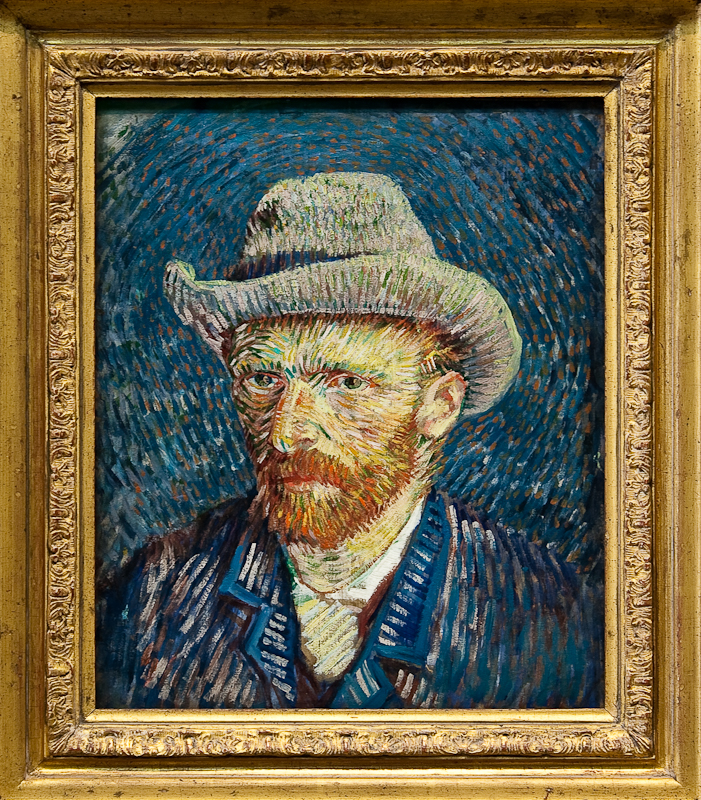
Looking at some of Vincent Van Gogh's self portraits, it can be difficult to impossible to tell what actual color his eyes were.  Just look at this self portrait from 1887 and your eyes will soon water from the strain. Some of his self-portraits hint that he had two different colored eyes.

It is also possible that Vincent himself did not know what color his eyes were.  He is thought to have experienced some color blindness.  He also had a habit of ignoring reality whenever it suited him.

My mother has blue eyes.  They are very apparently blue to me or just about anyone else that looks at her face.  However, she tells me that they look green.  My favorite singer Peter Gabriel, known for his soulful blue eyes, has sometimes told people that his eyes are actually green.

This got me thinking that Vincent may have seen his eyes in a way that no one else did. 

What is defiantly known is that he had ginger hair.  Men with ginger hair tend to have eyes that are blue. Artist A.S. Hartrick described Van Gogh's eyes as light blue.

Saturday, July 6, 2013

Interesting Facts and Information About Vincent Van Gogh

Not many artists inspire more awe and mystery than the legendary Vincent Willem Van Gogh (1853 – 1890.) Most people know him as a social outcast who cut off part of his own ear, painted some masterpieces and then died from a mysterious gunshot wound that (or may not) have been self-inflicted. But many facts surrounding Vincent’s life are even stranger than that whole ear thing.

Why He Signed his Paintings "Vincent"
Van Gogh signed most of his major paintings with his first name. Usually, an artist signed with initials or the last name. He was a Dutchman with a name easy for non-Dutch to spell but difficult to pronounce. "Van Gogh" is not pronounced "van go" or "van goff" but a sound difficult to reproduce in English spelling. The best approximation is "van hawkgh" to sound similarly (but not exactly) to "cough."

He was perhaps tired of hearing foreigners mangle his last name and so preferred to be called by the more easily pronounced Vincent. He also had a considerable talent for ticking off his family members, so he may have started signing "Vincent" in order to distance himself from the whole Van Gogh clan.

He Wasn't the Biggest Failure in the Family

Vincent was definitely the black sheep of his family, but he was nothing compared to his first cousin Hendrik Jacob Eerligh Van Gogh, the son of Vincent's uncle, Rear Admiral Johannes (Jan) Van Gogh (1817 - 1885). Uncle Jan made a fortune in his career and watched it all wash away when his son (Vincent's cousin) stole it all and escaped to America, where he would die just one year after his father. He is buried in Portland, Oregon.

Not much is known about Hendrik except that he was diagnosed with epilepsy and apparently drank a great deal. The only treatment for epilepsy back then was to stick the person in an insane asylum. No wonder he ran off to another continent entirely.

His Parents had Another Vincent Willem Van Gogh

Exactly one year before Vincent was born, a son was born to his parents and named Vincent Willem Van Gogh. Unfortunately, he was stillborn. The tiny body was buried at the church where Vincent's father worked. Every time Vincent went to church, he saw a grave with his name and birth date on it.

Although this would seem to be a significant detail in a man's life, it was basically ignored by Vincent and his family. The 1850s did have high death rates for babies and so reusing a good name perhaps made sense at the time.


More of my posts about Vincent's life:

Did Van Gogh Have Syphilis?
Did Van Gogh Like People?
Van Gogh's First Drawings

Monday, February 4, 2013

Why Did Van Gogh Give "Sorrow" an English Title?

Sorrow is one of Vincent Van Gogh's best drawings and also one of the best drawings of the human condition.  He drew it when he lived in The Hague in 1883.  At least two versions exist.  The one pictured here is a chalk drawing which now resides in London -- which is a tad ironic since that's exactly the city where Vincent intended it to go.  That it didn't go there until long after the artist's tragic death makes the drawing the title even more piognant.

Vincent didn't often write the titles of his works directly onto the work, but made a big exception here.   The model, his lover at the time, Clasina Maria Hoornik (nicknamed "Sien") is sitting on a seat  prominatly labelled "Sorrow."  Vincent chose the Engish word, even though he was Dutch and came into contact with French and German-speaking peoples more than English speakers.

Vincent had a very good command of English.  He could read it better than he could speak it.  He even worked in England for a while.  Vincent also knew French, German, a smattering of Latin and his native Dutch.  Why did he pick an English word for this drawing?

Vincent had been greatly moved and inspired by the illustrations in English periodicals such as The Illustrated London News.  He admired artists like Honore Daumier. In the late 1800s, adding photographs to magazines and newspapers were still too expensive, so periodicals used a stable of artists to bring the news to life.

Vincent had hoped that he could illustrate for those magazines and newspapers.  Sorrow was most likely drawn to showcase his talents to publishers.  However, Vincent never had a chance.  He was crushed when he discovered that such periodicals were reluctant to employ artists outside of their own officies.  His brother Theo would urge him to less drawing and do more painting, but Vincent kept on drawing for another two years before he dove into painting whole-heartedly.

Monday, January 21, 2013

Did Van Gogh Have Syphilis?

It's generally assumed that Vincent Van Gogh had syphilis because (quite frankly) 10% of all European men had it in the late 1800s.  He was diagnosed with another sexually transmitted disease, gonorrhea, in 1882.  Both STDs have similar symptoms so Van Gogh could have been misdiagnosed.

Van Gogh is thought to have had syphilis for 2 reasons:

  1. He frequented brothels
  2. He was kinda loopy
According to Van Gogh:The Life (Random House; 2012) Van Gogh did have syphilis about 1885.  During this time he had terrible mouth sores and lost a lot of weight because he was unable to eat. (See p. 447)
Unlike gonorrhea, syphilis caused insanity (or seeming insanity) in it's last stages, called neurosyphilis.  In teriary syphilis, the face become deformed, as seen in the bust of such a patient (pictured.)

According to The Lobotomist John Wiley & Sons; 2005), one fifth of all patients in American psychiatric wards had syphilis in the 1920s and 1930s.  The book, a biography of lobotomist Walter Freeman, includes some really vivid passages describing neurosyphilis patients, such as this little gem from page 59:

Though largely forgotten today, neurosyphilis was a terrible disease, a near epidemic that left its targets -- mainly men thirty and over -- in a wasted, twisted condition, riddled with bedsores and unable to speak coherently...They frequently grew demented, demented, incontinent and unable to control their muscles.
 
The problem is that Van Gogh was not really old enough to begin showing symptoms of neurosyphilis.  Men usually begin showing them 10 to 20 years after they get infected. 

My theory (and I think I'm alone on this one) that Van Gogh thought he had syphilis.  Since he had spent time in asylums, he saw what happened to men suffering in the final stages of neurosyphilis.  Perhaps one of the deciding factors in his suicide was that he feared developing those horrible final symptoms.

Sunday, January 13, 2013

Did Van Gogh Like People?


Vincent Van Gogh is often hailed as an artist that truly captured the human experience.  He wanted to paint portraits because he (at one time, anyway) thought it was the hardest form of art.

But did Van Gogh actually like people?  I'm going to go out on a limb and say that he didn't.  However, he felt guilty about it.

He never got on well with anyone for long stretches of time. Even his saintly younger brother Theo couldn't stand living with him.  Paul Gauguin got so sick of Vincent that he cut off part of his ear with a sword (according to some art historians anyway.)

Vincent, always lonely, preferred to stay alone.  Even in childhood, he could not get along with people.  In a photo from his schoolboy days, he crosses his arms and legs tightly as if daring anyone to get close.  The photo shown here shows Vincent with the same expression.

Being Dutch, Vincent was drilled on duty to family and to other people since practically the womb.  His letters to brother Theo seemed full of hope to help others when he was sent to the Borinage as a minister.

But people always disappointed him.  In this I (and I think others) can readily identify.  He never got over being sent to boarding school when he was 11, writing into adulthood about watching his parents drive off in a carriage while he was on the school steps.  All his romances were failures.  Even God rejected him when he was kicked out of the Borinage ministry because he was too unkempt and too much like a Borinage native than a proper Dutch clergyman.

People in his paintings and drawings are often very far away.  This could be due in part to his inability to hire models (making a silhouette was cheaper than a model) but done so often that he must have thought it looked right.  He was far away from other people.  Some paintings show his point of view, such as being far back in a row of dinner tables in Interior of a Restaurant in  Arles (1888).  The tables closest to him are empty.  The tables go back and forth like prison bars.

So no, I don't think he liked people, unless they were abstract.  He had a much more successful relationship with Theo through letter writing than whenever they met in person.  By the end of his short life, he felt more comfortable in solitude than with others.  His last trip to Paris in July of 1890 included a dinner with Theo, Henri Toulouse-Lautrec and 2 others who liked his work.  Before the last guest arrived, Vincent had slipped off, left the city and went back to Auvers.  He'd commit suicide three weeks later.

Saturday, January 5, 2013

Did Van Gogh Have a Sense of Humor?

I was reading one of my local library's biographies of Henri Toulouse-Latrec called The Tragic Life of Toulouse-Latrec (Random House; 1956) by the husband and wife team of Lawrence and Elizabeth Hanson.  My eyes widened as I read that Vincent Van Gogh "was without a sense of humor" which made him an unlikely companion for the witty Toulouse-Latrec.

Really?  Without a sense of humor?  Granted, his letters to brother Theo that have survived do not offer a lot of yucks.  But we are still talking about a man who did this oil painting, "Skull of a Skeleton with Burning Cigarette" (or, in his native Dutch Kop van een skelet met brandende sigaret).  This was done in Antwerp in 1885 or 1886.  The latter was the year Vincent moved from Antwerp to Paris.

Vincent apparently read French and understood French being spoken to him much better than he spoke it.  This may have caused him to appear humorless and a bit stupid to the Parisians.  Lawrence and Elizabeth Hanson state that Vincent stuttered when speaking French, but I haven't seen this mentioned in any other biography ... other than the one written by the Hansons, Passionate Pilgrim: The Life of Vincent Van Gogh (Random House; 1955.)

Friday, January 4, 2013

Van Gogh's First Drawings

Although Vincent Van Gogh didn't decide to become an artist until he was 27, he had drawn as a hobby.  Sometimes the legend of Van Gogh claims that he didn't draw anything until he was 27, but Van Gogh biographers (such as Michael Howard, author of Van Gogh: His Life and Works in 500 Images note that he drew often to amuse his brother Theo when the pair were children.  Some were done with a stick on dirt s the medium and some were pencil and paper.

Whatever the subject was of Vincent's very first drawing is unknown.  He probably did what many babies or toddlers do and drew a tightly bunched series of circles or other scribbles.  Most toddlers make their first scribbles when they are 18 months old, according to Sandra Crosser, Ph.D.  What age Vincent was when he first put a marking implement to a surface is unknown. 

Van Gogh got used to writing letters when he was very young.  Even in those letters, he'd fire off a sketch.  Decades after Vincent's death, these oldest of sketches and drawings were called the "Juvenilia" done when Vincent was still a youth.

It is unknown with 100% which drawing is Van Gogh's oldest surviving work.  The excellent website VGGallery.com estimates that a drawing known simply as "The Goat Herd" (pictured above) earns this distinction.  It has been dated 9 August 1862, when Vincent was nine years old.  The drawing now resides in a private collection.

I'm assuming this drawing is a fragment of a larger drawing, because I am unaware that one goat constitutes a "herd."  Even at such a young age, Vincent's human figures are bent with the world's worries.

Sunday, December 30, 2012

Was Van Gogh Colorblind?

Vincent Van Gogh, best known for his innovative used of colors in painting, may have been colorblind.  All snickers from modern art critics aside, there may be some truth to the theory.  It's estimated that 10% of all men cannot see colors normally.

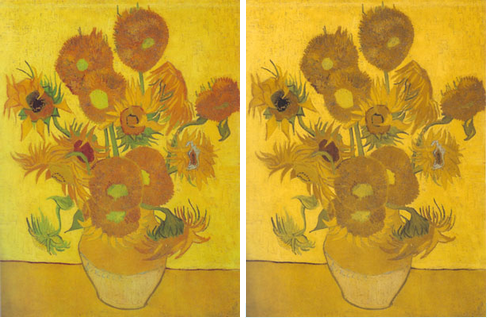
Vision expert (and app designer) Kazunori Asad, Ph.D. viewed many of Van Gogh's works through a special app clled the Chromatic Vision Simulator, which makes people who aren't colorblind see what the world looks like to colorblind people.  There are many types of colorblindness and the app adjusts for all of these types.

Anyway, Asad's theory is that Van Gogh had protanopia, or an inability to see reds.  Green would look like red to someone with protanopia.  This may explain why Van Gogh used blue, green, yellow and black heavily in his best-known works.  In some intances, there seems to be more detail revealed for someone with prontapia than for someone with normal color vision. 

I've seen the comparisons and I don't see that much of a difference.  For example, can you tell which is the real Sunflowers and which is the one seen through the app?  Neither can I, although I can see that the Sunflowers on the right is darker.  (That's the one those with protanopia see.)  Perhaps that mean that I have some trouble distinguishing between colors, too.  Van Gogh did not get on well with any of his art teachers and this may have been one of the reasons. 

This could also explain why Van Gogh's black and white drawings are often far more realistic than his best-known paintings.  He was able to judge the shades and colors better than for painting.  And yet he wrote in his letters that he felt driven to paint.  It could have been part of his nature to attempt the very things others told him that he could (or should) not do.

Van Gogh had red hair.  I wonder if he was able to see it or just took everyone's word that he had red hair. 

Thursday, December 27, 2012

Why Van Gogh Signed with Just His First Name

One of Vincent Van Gogh's more endearing traits was to sign his work "Vincent" instead of "Van Gogh" or "Vincent Van Gogh" or his initials.  The use of his first name reminds me of my classmates at school who would sign their art projects with just their first names.  I had such an unusual first name (Rena) that I rarely ever had to use my full name when turning in work for my grade school art projects for everyone to know who did the work.

Van Gogh was not the first artist to just use his first name as his artistic signature.  Matthew Howard, author of Van Gogh: His Life and Works in 500 Images (Lorenz Books; 2009) points out that Rembrandt (1606 - 1669) just used his first name.  (His full name was a whopper -- Rembrandt Harmenszoon van Rijn.)  Van Gogh greatly admired Rembrandt and wanted to be like Rembrandt.

Also, there was the problem of how to pronounce Van Gogh.  The Dutch didn't have a problem with it, but Van Gogh spent a large part of his life in other countries -- countries where the natives had great difficulty trying to pronounce Van Gogh.  Even today in this age of international air travel and the Internet, on both sides of the Pond, you'll find art historians and collectors saying "van GO"  or "van GOCK."  That constant mangling of his name had to have gotten on Vincent's notoriously taunt nerves.

Howard also noted in his impressive book that Vincent didn't want to be a Van Gogh anymore after his traumatic experiences as a minister at the Borinage.  He got into constant heated arguments with his family, especially his father, and so felt that he wasn't a "real" Van Gogh anymore.  Ironically, Vincent became the most famous Van Gogh of them all.

Monday, December 24, 2012

Van Gogh and Absinthe

It's no secret that Van Gogh was addicted to absinthe, a green drink that became so feared it was banned, being castigated as "the Devil in a bottle."  It was thought to cause hallucinations and was blamed for a murder in the early 1900s.  Absinthe is legal in many countries.

The main ingredients were  wormwood, florence fennel and green anise.  (If you wonder what anise taste likes, wonder no more.  It tastes like black liquorice.)  A sugar cube and water was often added to it just before drinking.  The intoxicating ingredient is thujone, found in wormwood.  Thujone is in a class of chemicals called terpenes.  Terpenes are also in turpentine, which Van Gogh reportedly tried to drink and in his paints, which he did eat at times. 

Any "absinthe" drinks available today are much milder than what was available in the late 1800s when Vincent Van Gogh lived.  Back then, one glass of absinthe could have as much as 70% alcohol, giving it a 140 proof sock to the gut. A chemical anaysis of 100 year old bottles by the Chemical and Veterinary Investigation Laboratory of Karlsruhe in Germany in 2008 did not find any hallucinatory substances present and as much thujone as in modern absinthe.

However, you're not supposed to drink it neat, but mixed with water and sugar.   Each manufacturer of absinthe used a different amount of wormwood, so it's unsure how much thujone contributed to drunkenness, dreamy sensations or other symptoms.  Just how dangerous and how addictive absinthe actually was is a source of never-ending debate by historians, doctors and the generally curious.

Absinthe was a commonplace drink in Europe.  Other known absinthe drinkers include Henri Toulouse-Latrec, Oscar Wilde, Ernest Hemingway, Arthur Rimbaud and the infamous "wickedest man in the world" Aleister Crowley.

Does absinthe cause an upsurge in creativity?  Probably not any more than any other kind of drug or alcoholic beverage.  Some art historians claim that absinthe hallucinations may explain some of Van Gogh's more bizarre paintings and his suicide.  Hideous Absinthe: A History of the Devil in a Bottle (I.B. Tauris; 2004) points out that absinthe wasn't as addictive as any other alcoholic drink.  Addictions were thought to be moral failures rather than chemical diseases, so the ban on absinthe seems a bit silly today. 

Image is "Still Life with Absinthe" by Van Gogh, oil on canvas, 1887.

Did Vincent Van Gogh Have a Cat?

[I feel] like a cat in unfamiliar surroundings. -- Vincent in a letter  to brother Theo, 1878

In 2010, a popular children's book was published by Scholastic called Vincent Van Gogh's Cat.  What made the book so unusual was that it was written and illustrated by second grade kids from East Washington Academy in Munice, Indiana, with help from an adult named Deborah Brown.

This little book has introduced many chidren to art and not just Van Gogh's art.  This has even inspired a new generation of artists, such as Mrs. Maynard's kindergartener art class.

However, there 's no evidence that Van Gogh ever had a cat. After he lost his job at an art dealer's in London, he became impoverished.  He couldn't feed himself, let alone a pet cat. 

It could be argued that Vincent was the pet of his younger brother Theo, who inancially supported Vincent for most of the artist's life.

This sketch, "Hand with Bowl and Cat" was done in black chalk on laid paper while Vincent lived in the village of Nuenen in 1885, five years before his death.  Vincent preferred to draw from models, so chances are high that this sketch was based on a real sleeping cat around Neunen.  The once worthless sketch now resides at the Van Gogh Museum in Amesterdam.  No word as to how much the sketch is worth now.  Neunen is now home to the Van Gogh Village Museum.

Below is a sketch from one of Vincent's letters from Auvers in 1890 (the last year of his life), "Daubingny's Garden with Black Cat."

Saturday, December 22, 2012

Where Was Vincent Van Gogh Born?

Vincent Willem Van Gogh was born on 30 March 1853 at the parsonage in the Dutch town of Goot-Zundert (which means "Big Zundert"), in the vicarage of Zundert.  There was a nearby town called Klein-Zundert (meaning "Little Zundert").  The parsonage, (pictured at left) built sometime in the 1600s, was directly across the street from the busiest place in town, the Markt ("Market").

Vincent's birth happened exactly one year (to the day) that Anna Van Gogh gave birth to a stillborn son -- named Vincent Willem Van Gogh.  Anna's second son and first living baby both bore the same name.  It was Vincent's father that decided on the names, according to Jp. A. Calosse, author of Van Gogh (Parkstone International; 2011).

Zundert was (and still is) in the provence of North Brabant, located in the south of country, near the border with Belgium.  At the time of Van Gogh's childhood, it was a predominately rural area.  To this day, some of the area is still used for farmland, particularly for growing strawberries.  Back then, the big crops were potatoes and a very fine white sand used for sanding wood smooth.  While Vincent lived in Groot-Zundert, the population was around 1200.

The village itself only consisted of a few buildings while the rest of the population lived on farms miles away from each other.  the village had one main road called the Napoleonsweg, after Napoleon, who had ordered the road's construction around 1810.  The area was mostly devoid of trees, except for the oak and beech trees lining the Napoleonsweg.

Groot-Zundert harbored strongly conventional ideas that were opposed to the more liberal attitudes along the Dutch coasts.  Most of the inhabitants were very poor were exploited by the higher classes.  Back then, citizens had to pay a stiff poll tax in order to vote, ensuring that the poor never could go to the polls.  Van Gogh's family was one of the wealthier families in the town. 

Friday, December 21, 2012

What Was Vincent Van Gogh's Middle Name?

Vincent Van Gogh's middle name was NOT Van but Willem.  He was named after three people: 

  • his uncle, Vincent Van Gogh, known often in the family correspondence as "Uncle Cent", but I do not know what his particular middle name 
  •  his brother Vincent Van Gogh, who would have been Vincent's older brother had the baby survived, but alas, the first Vincent Willem was a stillborn.  He was born and pronounced dead on arrival on 30 March 1852, a year to the day before our Vincent Willem was born.  The gravestone is pictured above.
  • his paternal grandfather, Vincent Van Gogh (1780 - 1874) a minister who is thought to have been named after his uncle, a sculptor named (you guessed it ) Vincent Van Gogh (1729 - 1802.) 

The name Willem and the feminine version Willemina pop up frequently in Dutch names, but I have not been able to determine if the Willem part of Van Gogh's name is after any particular relative.

Willem (English equivalent William) is a two-part name. The "Wil" part means "desire" while the "lem" part means "helmet" or other protective  headgear.  So, putting it all together, "Willem" means "desire helmet."  Not a particularly apt name for our lad Vincent.

Wednesday, December 19, 2012

My 3 Favorite Van Gogh Quotes

Vincent Van Gogh was a better painter than he was a writer, but some gems stand out from the hundeds of letters he wrote to his brother Theo which still survive.  In particular order, my three favorites are:

When I have a terrible need of - shall I say the word - religion. Then I go out and paint the stars.

I dream of painting and then I paint my dream.

I have put my mind and soul into my work and have lost my mind in the process.

Just these three lines gives us a tantalizing glimpse into Van Gogh the man as opposed to Van Gogh the legend.  Remember, Van Gogh was a failed lay preacher.  His order kicked him out from his assigned area of the Borinage, an impoverished mining town in Belgium.  Why did they kick hi out?  Because he acted like one of the locals instead of being better than the locals.  There was a more official explanation, but that's basically what his superiors meant.  Getting kicked out by his order must've been like getting kicked to the curb by God.

So, God was not to be any source of faith for Van Gogh.  According to these quotes, he turned to dreams, the stars and his art.  The stars appear in several of Van Gogh's most memorable works, including:
The third quote shows that Van Gogh was not as crazy as he is often made out to be.  It is still unknown what mental illnesses or other chronic ilnesses like frontal lobe epilepsy suffered from, but he was prone to wild mood swings.  His behavior became so bad that the entire town of Arles, France booted him out.  He loved to create and yet could not make a living out of it.  He was ridiciuled by contenporary artists and even kicked out of an art course at Antwerp Academy.  Van Gogh got kicked around so much I wonder if he had a permanent boot mark on his butt.

There is also a theory that Van Gogh shot himself because Van Gogh believed he couldn't pain anything better.  He could not live without being caught in the intoxicating vice-grip of creative flow and decided to call it a life.

Although Van Gogh must have been next to impossible to live with, when I read these quotes, I can't help but sympathise.  How many of us willingly toil on and on at something we love, even though we can't afford to?

Image of a letter Vincent sent to Theo of his bedroom in Arles, 17 October, 1888


Thursday, December 13, 2012

How Van Gogh Lost Part of His Ear

 
Vincent Van Gogh (1853 – 1890) is today best known for cutting his ear off to give to a prostitute. The story of Van Gogh’s ear is so popular that novels and a café have been named after it. This story has been perpetuated in popular media such as Irving Stone’s best-selling biographical novel about Van Gogh, Lust for Life (1934).

Unfortunately, there seems to be no evidence beyond these stories that Van Gogh ever cut off his own ear. Van Gogh did injure his ear in December 23, 1888 but did not slice off the entire ear. But just how the ear was injured is still shrouded in mystery. One of Van Gogh's most famous paintings is his "Self-Portrait with Bandaged Ear" painted around one month after the injury.

The Paul Gauguin Theory

Many art historians believe that Van Gogh sliced off part of his own ear after a furious argument with fellow impoverished artist, Paul Gauguin. Van Gogh had hoped to start an artist colony in the yellow house in Arles he rented. The only artist who warmed up to this idea was Gauguin and only because he needed a roof over his head.

Gauguin was notorious for his infuriating and intensely selfish behavior. He must have been like a bucket of ice-cold water on Van Gogh's dreams. But despite their differences, Van Gogh still felt some loyalty to Gauguin. Historians Hans Kaufmann and Rita Wildegans argue that Gauguin accidentally sliced off part of Van Gogh's ear with his fencing sword during one of their numerous arguments. Van Gogh then told the police that he cut his own ear in order to protect Gauguin. He may also have been protecting himself, since he may have physically attacked Gauguin, which caused him to reach for his sword in the first place.

The Vincent Van Gogh Theory

Other art historians claim that Van Gogh cut off part of his own ear with a razor not hoping to impress his favorite prostitute but in a strange revenge on Gauguin. Historians tend to agree that the two did argue violently on December 23, 1888. Gauguin decided to leave Van Gogh but a dejected and possibly jealous Van Gogh wanted him to stay.

Van Gogh may have cut off part of his ear so he could blackmail Gauguin into staying. Van Gogh could blame the injury on Gauguin in order to get him arrested. Van Gogh apparently had second thoughts and told everyone he'd injured himself. Whatever the reason, Van Gogh had just over a year to live before dying of a gunshot wound.
 

How to Pronounce "Van Gogh"

There's one thing I've learned since my first childhood infatuation with Vincent Van Gogh -- no one in America knows how to pronounce the name.  I wasn't until I lived in the UK that I discovered that the name is not "van go" or even "van gock" but... well... it's best explained here in a memorable episode of QI:


Sunday, December 9, 2012

Myths and Facts About Vincent Van Gogh


Did Dutch artist Vincent Van Gogh (1853 - 1890) sell only one painting in his lifetime? Did he really cut off his own ear as a cheap Christmas present for his girlfriend? And did this tortured genius really commit suicide? Ever since his death in 1890 at the age of 37, his legend has eclipsed his actual life. Here we sort through the myths and the facts about Van Gogh ....


Read my full article at Knoji.com. Please. I need the pennies. Thanks!

"Self Portrait with Straw Hat" (1887) image from Wikimedia Commons