Showing posts with label van goghs friends. Show all posts

Friday, March 20, 2015

"The Yellow House: Van Gogh, Gauguin, and Nine Turbulent Weeks in Arles", By Martin Gayford: A Review

(This review first appeared at Goodreads. That's where I've been spending a shameful amount of time instead of updating this blog. ANYWAY --)

There was a telemovie made in the UK in 2007 based on this book by Martin Gayford (Little, Brown & Company). For once, the movie wound up being much better than the book. This book promises more than it can deliver. Just what happened between Paul Gauguin and Vincent Van Gogh remains just as mysterious as before reading this convoluted book. Although it is generously illustrated, none are in color -- a great handicap for two artists who were so devoted to color.

There are much better books about Van Gogh out there than "The Yellow House."

I was also disappointed at how much this book spent on Gaugain's life after the Yellow House. The book could have been better if it focused on the time of the Yellow House and only mentioned what happened to Gauguin briefly. The author apparently had very little material to work with and decided to milk it for what it was worth.

Friday, July 4, 2014

An Overview of Van Gogh's Relationships

Vincent Van Gogh (1853 - 1890) painted people with remarkable sympathy but failed to get along with people in real life. He was deemed a failure by most of his family, had no lifelong friends and never married. In his entire short life, he had just one trusted confidant - his younger brother Theo. Theo was so attached to Vincent that he died a mere six months after his older brother.

Van Gogh's Family

Vincent was the oldest son of five children. He was born about one year after his mother gave birth to a still born son named Vincent. His father was a pastor, but more importantly his Uncle Vincent worked as a successful art dealer for the French firm Goupil & Cie. Vincent originally was going to follow his uncle's footsteps and sell art as opposed to creating it. He even worked in Guopil & Cie.'s London branch for two years.

Vincent did not receive any support from his large family with the sole exception of his brother Theo. Most of Vincent's letters to Theo survived and have been published. Vincent was considered bizarre and a misfit by his other family members. Vincent tried to woo his widowed cousin but she refused him. This caused a huge rift in the family that already was pushing Vincent away.

Van Gogh's Lovers

Although the legend claims that Vincent cut his ear off as a present for his favorite whore, this legend has been debunked. But Vincent did go to prostitutes. No "decent" woman would have anything to do with him. Modern doctors state that Vincent's bizarre behavior may have been the result of a combination of mental illness and a chronic ailment such as epilepsy or migraines.

Vincent moved to The Hague in 1881. In 1882, he met a pregnant prostitute, Clasina Maria Hoornik, and fell in love with her. They lived together, which caused a major scandal. The relationship was doomed from the start, but Vincent's tenderness towards his lover shows in his drawings of her, including the much loved Sorrow.

Van Gogh's Contemporaries

Most other artists would not have anything to do with Vincent, since his poverty made him have poor grooming habits and his ailments made his behavior unpredictable. He did briefly study under Anton Mauve, then a famous Dutch realistic painter. But Mauve soon tired of his scandalous student and soon would have nothing to do with him.

The only artist to attempt to collaborate with Vincent was yet another social misfit, Paul Gauguin. They briefly shared lodgings at Arles, France but often fought. Both were alcoholics and both were impoverished. Some biographers claim it was Gauguin who cut off part of Vincent's ear.

Additional References

Van Gogh.Rene Huyghe. Crown Publishers; 1967.

Dear Theo: The Autobiography of Vincent Van Gogh. Irving Stone & Jean Stone, editors. Plume; 1995.

Thursday, June 26, 2014

"Leaving Van Gogh"; By Carol Wallace: A Review

If you liked Lust for Life (1934) by Irving Stone, then you are going to be really disappointed with Carol Wallace's Leaving Van Gogh (2011.) Stone did the historical novel thing so much better and with far more intensity and focus than Wallace's rather sloppy word-portrait of both Vincent Van Gogh and his last therapist, Dr. Paul Gachet (yes -- the same Dr.Gachet of the infamous portraits.)

A far more interesting book would have been speculation on whatever happened to the painting Portrait of Dr. Gachet (1890), which disappeared in 1990 after being bought by a really rich Japanese guy.

The novel is told from Dr. Gachet's point of view. Granted, Dr. Gachet is one of the more mysterious characters on the fringe of art history. He was not only a bad amateur artist and spectacular art collector, he also treated Impressionists like Renoir. He clearly made a big impression on Van Gogh, which is why he did the portrait in the way he did.

The plot is all over the place. Dr. Gachet goes into flashbacks into most inconvenient times, which really interrupts the narrative. The big revelation of the novel turns out to be no revelation at all. Dr. Gachet sees Van Gogh in rose-tinted spectacles, which really clashes with the historical portrait we have of him. YES, I know this is work of fiction, but HONESTLY!


Wednesday, May 22, 2013

"Van Gogh: His Life and Works in 500 Images"; By Michael Howard: A Review

If you only get  one book about Vincent Van Gogh, make it Van Gogh: His Life and Works in 500 Images by Michael Howard (Anness; 2010.) It's the most succinct look at Van Gogh's life, body of works and influences that I've ever come across.  It also makes a great gift for any Van Gogh fan that wants a good collection of works.

Yes, there have been more detailed biographies on Van Gogh, but this isn't as exhausting, sensationalistic or skimpy as presented in other biographies.  Since this is a heavy book, it's good that the pages keep on turning rather than having to wrestle with teeny-tiny print on huge pages (like Steven Naifeh's monster Van Gogh: The Life.)

The 500 images are not all Van Gogh works.  They also include images of paintings and illustrators that inspired and influenced Van Gogh.  It also includes works of Van Gogh's contemporaries, including Paul Gauguin. 

This hardback coffee-table book is part of Anness' series on major artists which include a brief biography and an in-depth veiw of many of that artist's works.  Other artists in the series include Cezzane, Renoir, Degas, Turner and Monet.  There is also a book devoted to one of Van Gogh's biggest influences, Rembrandt.

Friday, February 8, 2013

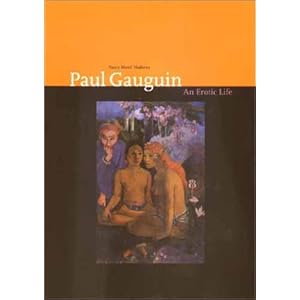
"Paul Gauguin: An Erotic Life"; By Nancy Mowll Mattews: A Review

No other artist impacted Vincent Van Gogh than Paul Gauguin -- literally.  Gauguin is thought to have been responsible for cutting off part of Vincent's ear.  Vincent, not wanting to lose a man he so admired, told others he cut it off himself. 

Gauguin was magnetic, intelligent and an utter bastard.  He wanted to be seen as living the erotic life that was the envy of all other men, which is why Professor Nancy Mowll Matthews titled her extensive biography Paul Gauguin: An Erotic Life (Yale University Press; 2001.)

This is a large, heavy book with very small print and lots of endnotes.  I hate endnotes.  I realize that footnotes are essential for establishing and embellishing facts presented in the text, but this gets out of hand.  Some people may like flipping back and forth from the text to the notes, but in this case it got to be ridiculous.  Why not just add the endnote information in the damn text?  Because that's not the way biographies are properly done, apparently.

I have to admit, I do not like most of Gauguin's work.  Yes, I realize he was pushing boundaries, breaking new ground and championed working from imagination rather than just from life, but his stuff creeps me out more than H. R. Geiger's stuff (and he designed the Alien for Alien (1979.)

Despite the title, the book does not have much about Gauguin's sex life or imaginary sex life but does talk to great length about how much he hated women.  It also describes the cruelties Gauguin would casually inflict on anyone he encountered.  He also left his wife and five children high and dry while he went and lived the high life as one of the most famous artists of his day.

The book also hints that Gauguin was somehow responsible for Vincent's final breakdown which lead to his suicide but does not follow up on these hints.  I have to admit, I couldn't wait for Gauguin to die because he was such scum.  Yes, many of his works are considered masterpieces, but Now I know why most of his subjects have such evil expressions on their faces.

Wednesday, January 30, 2013

"The Tragic Life of Toulouse-Latrec"; By Lawrence & Elizabeth Hanson: My Review

Why am I talking about a book on Henri Toulouse-Latrec on a Van Gogh blog?  Well, the two knew each other, albeit briefly.  I think Vincent's work was influenced by Toulouse-Latrec's work, although I'm not sure many art historians and critics would agree with me.  Reading  about Vincent's contemporaries helps not only flesh out the times that Vincent lived in, but also helps you appreciate what Vincent was comparing himself to.

Which brings us to The Tragic Life of Toulouse-Latrec (Random House; 1956) by the husband and wife team of Lawrence and Elizabeth Hanson.  The couple also wrote biographies of Van Gogh and Paul Gauguin.  I haven't read those and think I may skip them.  This book was enough.

This is not a particularly detailed biography and suffers from some of the biographers' criticism of his private life.  However, this is one of the shortest biographies out there.  If you do not have a lot of time and know elementary French, then this book will be okay.

Although Vincent was considered freakish by the French because of his intensity, his penchant for pissing people off and his problems speaking French, Toulouse-Latrec drew horrified stares or quickly averted eyes.  His parents were first cousins and boy, did it show in Toulouse-Latrec's dwarfish and incredibly fragile body.  He wasn't a dwarf in that he did not suffer from dwarfism, but his legs broke when he was a child and he basically stopped growing then.

Sadly, this book has very few illustrations -- all of  which are in black and white.  Read it and Google the works described.