Saturday, January 5, 2013

Did Van Gogh Have a Sense of Humor?

I was reading one of my local library's biographies of Henri Toulouse-Latrec called The Tragic Life of Toulouse-Latrec (Random House; 1956) by the husband and wife team of Lawrence and Elizabeth Hanson.  My eyes widened as I read that Vincent Van Gogh "was without a sense of humor" which made him an unlikely companion for the witty Toulouse-Latrec.

Really?  Without a sense of humor?  Granted, his letters to brother Theo that have survived do not offer a lot of yucks.  But we are still talking about a man who did this oil painting, "Skull of a Skeleton with Burning Cigarette" (or, in his native Dutch Kop van een skelet met brandende sigaret).  This was done in Antwerp in 1885 or 1886.  The latter was the year Vincent moved from Antwerp to Paris.

Vincent apparently read French and understood French being spoken to him much better than he spoke it.  This may have caused him to appear humorless and a bit stupid to the Parisians.  Lawrence and Elizabeth Hanson state that Vincent stuttered when speaking French, but I haven't seen this mentioned in any other biography ... other than the one written by the Hansons, Passionate Pilgrim: The Life of Vincent Van Gogh (Random House; 1955.)

Friday, January 4, 2013

Van Gogh's First Drawings

Although Vincent Van Gogh didn't decide to become an artist until he was 27, he had drawn as a hobby.  Sometimes the legend of Van Gogh claims that he didn't draw anything until he was 27, but Van Gogh biographers (such as Michael Howard, author of Van Gogh: His Life and Works in 500 Images note that he drew often to amuse his brother Theo when the pair were children.  Some were done with a stick on dirt s the medium and some were pencil and paper.

Whatever the subject was of Vincent's very first drawing is unknown.  He probably did what many babies or toddlers do and drew a tightly bunched series of circles or other scribbles.  Most toddlers make their first scribbles when they are 18 months old, according to Sandra Crosser, Ph.D.  What age Vincent was when he first put a marking implement to a surface is unknown. 

Van Gogh got used to writing letters when he was very young.  Even in those letters, he'd fire off a sketch.  Decades after Vincent's death, these oldest of sketches and drawings were called the "Juvenilia" done when Vincent was still a youth.

It is unknown with 100% which drawing is Van Gogh's oldest surviving work.  The excellent website VGGallery.com estimates that a drawing known simply as "The Goat Herd" (pictured above) earns this distinction.  It has been dated 9 August 1862, when Vincent was nine years old.  The drawing now resides in a private collection.

I'm assuming this drawing is a fragment of a larger drawing, because I am unaware that one goat constitutes a "herd."  Even at such a young age, Vincent's human figures are bent with the world's worries.

Monday, December 31, 2012

Documentary: "The Forger's Masterclass, Episode 3: Van Gogh"

I wish I had a dollar for every time I've heard, "Oh, anyone can paint like him!"  The him referred to being Vincent Van Gogh (1853 - 1890.)  If you think you can paint like Van Gogh, go right ahead and try. All power to you.

Of course, the odds of you being able to do it are slim to none.

This is proven is a half-hour documentary series called The Forger's Masterclass, hosted by convicted art forger John Myatt (who looks a little like Van Gogh).  Myatt did porridge in Brixton Prison -- which is probably still nicer than Alcatraz ever was, but still an awful place.  No, I've never been there, but during my years being homeless in the UK, I met several people who did. 

Anyway, this is the third episode in the series, where Myatt tries to get three art students to balance both passion and control by having them paint their self-portraits in the style of Van Gogh's blue swirly hatless self-portrait from 1889.

Although some of the biography information about Vincent is questionable and the name is constantly mispronounced, it's still an eye-opening program.  It was well worth 28 minutes of my life.  Enjoy.

Painting Focus: White House at Night (1890)

The enigmatic, mysterious Vincent Van Gogh (1853 - 1890) painted the masterpiece "The White House at Night" a few weeks before he died of a gunshot wound. It is also known by its French name, "La maison blanche du nuit" because Van Gogh painted it from life in the French village of Auvers-su-Oise, the village where he would die. "The White House at Night" shows Van Gogh at the full flower of his artistic powers.

Considered worthless before the paint even dried, it is now considered priceless. The oil painting's last known location was the Hermitage Museum in St. Petersburg, although it has apparently been in storage since 1995, although the painting can be seen on the museum's webpage. In the chaos of World War II, the Russian military stole the painting from German art collector and factory owner Otto Krebs.

The Painting's Subject Matter

The White House in question is not the infamous home of the American President but a small French cottage with a red roof, green shutters, yellow chimneys and white-washed walls. The house is flanked by cypresses and other trees which stand like soldiers on sentry duty. The front of the house is obscured first by large green shrubs and then by a yellow wall encircling the house. The front door is completely covered up.

Two fashionable ladies in the corpulent dresses of the day walk through the front gate, their backs to the viewer, while another woman dressed in black and carrying a basket walks on the path towards the viewer. High above is the night sky - although the sky is day-blue. At first it seems like a huge yellow sun is there, but since it is night time, the orb is actually a star, most likely Venus. This type of star is seen in many other Van Gogh paintings, including his infamous "The Starry Night" (1889.)

Death Takes a Holiday

At first glance, this painting seems to be a calm summer's day in a picturesque French village, but one has to wonder if Van Gogh was contemplating suicide as he painted it. The Hermitage Museum states that Van Gogh made the white house look like a prison. Certainly there seems no way in to the viewer because of the wall and the foliage. And why is there a sudden splash of red in two of the windows on the upper floor?

All of the women in the painting are wearing black. The woman walking towards the viewer seems elegant and young. On closer inspection, her sickly pale skin and pained expression makes her resemble the traditional figure of Death more than any French belle. Her wavy hair looks more like a hood for her black cloak than hair touching a dress.

Sunday, December 30, 2012

Was Van Gogh Colorblind?

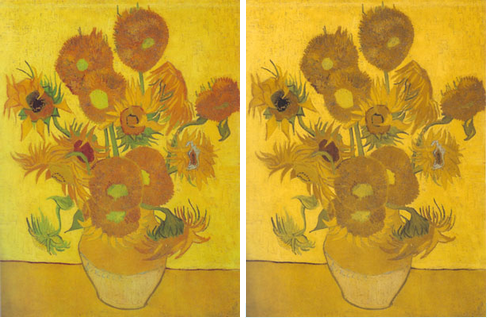
Vincent Van Gogh, best known for his innovative used of colors in painting, may have been colorblind.  All snickers from modern art critics aside, there may be some truth to the theory.  It's estimated that 10% of all men cannot see colors normally.

Vision expert (and app designer) Kazunori Asad, Ph.D. viewed many of Van Gogh's works through a special app clled the Chromatic Vision Simulator, which makes people who aren't colorblind see what the world looks like to colorblind people.  There are many types of colorblindness and the app adjusts for all of these types.

Anyway, Asad's theory is that Van Gogh had protanopia, or an inability to see reds.  Green would look like red to someone with protanopia.  This may explain why Van Gogh used blue, green, yellow and black heavily in his best-known works.  In some intances, there seems to be more detail revealed for someone with prontapia than for someone with normal color vision. 

I've seen the comparisons and I don't see that much of a difference.  For example, can you tell which is the real Sunflowers and which is the one seen through the app?  Neither can I, although I can see that the Sunflowers on the right is darker.  (That's the one those with protanopia see.)  Perhaps that mean that I have some trouble distinguishing between colors, too.  Van Gogh did not get on well with any of his art teachers and this may have been one of the reasons. 

This could also explain why Van Gogh's black and white drawings are often far more realistic than his best-known paintings.  He was able to judge the shades and colors better than for painting.  And yet he wrote in his letters that he felt driven to paint.  It could have been part of his nature to attempt the very things others told him that he could (or should) not do.

Van Gogh had red hair.  I wonder if he was able to see it or just took everyone's word that he had red hair. 

Thursday, December 27, 2012

Painting Focus: Portrait of Dr.Gachet (1890)

“I have a portrait of Dr. Gachet with the heart-broken expression of our times.” - Vincent Van Gogh in a letter to Paul Gauguin

Vincent Van Gogh (1853 – 1890) wanted to be a portrait painter. Because of his poverty, he could not afford to hire models to sit for him. Although best known for his wildly imaginative representations of common scenes from everyday life, Van Gogh needed the subjects before him in order to create. He could not draw or paint from imagination or memory.

One of the people who did sit for Van Gogh was his final doctor, Paul Gachet (1829- 1909.) Dr. Gachet not only was Van Gogh’s doctor, but was also a fan. Gachet admired many artists of the time, including Paul Cezanne and Camille Pissarro. Van Gogh produced several versions of the good doctor’s portrait. The most famous version, done in oil paints, (pictured at left) fetched a staggering $82.5 million in 1990. Unfortunately, this version has disappeared.

Painting General Description

This portrait is different from most other portraits for several reasons. Instead of sitting up straight, Dr. Gachet is slouched to one side, resting his head against one hand. On the table in front of him is a bunch of foxglove. The table also holds two books by Edmond and Jules Goncourt - Manette Salomon and Germinie Lacerteux. The former book is about four artists who live and die in obscurity. Gachet's coat is almost the same dark color as the wall, making him almost disappear into the background.

The brightest spot on the painting is the good doctor's white collar, bits of shirtsleeves peeking out of his coat sleeves and part of his dull white hat. But the most eye-catching feature is Dr. Gachet's expression. He's tired, resigned and possibly depressed. Modern doctors have speculated whether Gachet suffered from Addison's disease, because Gachet's nails are too pale in comparison to his skin.

Why So Sad?

Van Gogh would shoot himself a few months after completing his Dr. Gachet portrait series. Some art historians have speculated that Van Gogh showed the doctor looking so sad because Van Gogh was already considering suicide. Van Gogh's affectionate portrait reveals a level of intimacy that is not seen in most of his other portraits. Perhaps Van Gogh was trying to apologize for his suicide before he committed the act.

Another interpretation was that Dr. Gachet was an absinthe and foxglove tea addict, so Van Gogh merely portrayed the expression he most saw the doctor give the world. Another interpretation is that Van Gogh himself was tired of life and expressed his feelings in the face of his doctor, benefactor and friend.

Why Van Gogh Signed with Just His First Name

One of Vincent Van Gogh's more endearing traits was to sign his work "Vincent" instead of "Van Gogh" or "Vincent Van Gogh" or his initials.  The use of his first name reminds me of my classmates at school who would sign their art projects with just their first names.  I had such an unusual first name (Rena) that I rarely ever had to use my full name when turning in work for my grade school art projects for everyone to know who did the work.

Van Gogh was not the first artist to just use his first name as his artistic signature.  Matthew Howard, author of Van Gogh: His Life and Works in 500 Images (Lorenz Books; 2009) points out that Rembrandt (1606 - 1669) just used his first name.  (His full name was a whopper -- Rembrandt Harmenszoon van Rijn.)  Van Gogh greatly admired Rembrandt and wanted to be like Rembrandt.

Also, there was the problem of how to pronounce Van Gogh.  The Dutch didn't have a problem with it, but Van Gogh spent a large part of his life in other countries -- countries where the natives had great difficulty trying to pronounce Van Gogh.  Even today in this age of international air travel and the Internet, on both sides of the Pond, you'll find art historians and collectors saying "van GO"  or "van GOCK."  That constant mangling of his name had to have gotten on Vincent's notoriously taunt nerves.

Howard also noted in his impressive book that Vincent didn't want to be a Van Gogh anymore after his traumatic experiences as a minister at the Borinage.  He got into constant heated arguments with his family, especially his father, and so felt that he wasn't a "real" Van Gogh anymore.  Ironically, Vincent became the most famous Van Gogh of them all.