Monday, September 30, 2013

Painting Focus: Portrait of Patience Escalier (1888)

One of Vincent Van Gogh's best-loved portraits is that of an old gardener named Patience Escalier.  There are at least three versions (one drawing and two paintings) but the image on the left is the best known version.

In the summer of 1888, struggling artist Vincent Van Gogh dreamt of starting an artist’s colony where he lived in Arles, France. He’d managed to persuade one artist, Paul Gauguin, to join him. However, Gauguin had yet to arrive. In order to help entice artists to the area, Van Gogh painted many portraits of the inspiring local people he came across. Because of his poverty and strange ways, it was very difficult for him to get a hold of models...

Please read the rest of my article at Helium.  Thanks!
(Link has now been fixed.)

Other paintings in my Painting Focus series include:

Tuesday, September 17, 2013

New Van Gogh Painting Discovered (Sorta)

Earlier this month, art experts from the Van Gogh Museum in Amsterdam announced that a painting stored in an attic for 80 years is a genuine Van Gogh.  80 years ago, a Norwegian collector bought it thinking that it was genuine and was bitterly disappointed when it was declared a fake.  When it was bought a few years ago by an anonymous family, they had the painting reassessed.  They waited two years for a final report.

Why is it now considered genuine?  Because researchers unearthed two newspaper articles that article mentioned this painting, "Sunset at Montmajour"   The first article was a review of an Amsterdam art exhibit from 1892.  The second was a review from an art exhibit in the Netherlands in 1901.  It was then that the painting disappeared.

Another reason is that we can do something that we couldn't do 80 years ago -- we can chemically analyze pigments from one painting to see if it matches another.  Pigments from "Sunset at Montmajour" were a match to many other known Van Gogh paintings at the Van Gogh Museum in Amsterdam.  Experts can also X-ray the canvas to see if it matched other Van Gogh canvases.

The painting is not a masterpiece by a long stretch.  When I first saw it, I promptly forgot what it looked like ten minutes later.  That may be more of a criticism of my memory than this particular Van Gogh painting, but even the art critic of the Guardian was not impressed, who wrote that "even great artists have bad days." (Owie.)

Some Doctor Who fans love it because the buildings in the top left corner look remarkably like the good Doctor's TARDIS.

There are numerous artworks by Van Gogh that are missing.  There are also artworks mentioned in his letters that do not seem to match the works known to exist or has existed.  "Sunset at Montmajour" was such a painting.  According to a letter from Van Gogh to his long-suffering brother Theo, he painted this on July 4, 1888.


Monday, September 16, 2013

YouTube Video: Vincent's Final Moments

The most famous mentally ill artist in history was arguably Vincent Van Gogh (1853 - 1890.) At the age of 37, Vincent staggered into the hotel he was staying over a café with a bullet wound in his abdomen. He was examined by a doctor.  The bullet could not  be removed without killing Vincent.  He lingered for two days and died. He claimed he harmed himself and urged no one other than himself to be blamed for his death.  It is possible that he was shot by a teenaged boy, but Vincent apparently wanted to die anyway.

Although the historical details in this very short independent film are debatable, I'm not highlighting it here for it's accuracy.  It is a very good portrayal of someone who has decided to die.  If you or someone you know has trouble understanding why anyone would want to kill themselves or want to die while relatively young, watch this.  It gives a good view of why suicide can seem like a perfect solution and why preventing suicide can be so difficult.

(Because of a technical problem in Blogger, I cannot place the YouTube video directly into this blog post. Sorry!)

Some more videos on YouTube about Vincent Van Gogh include:

New Van Gogh Movie in the Works

As Sherlock Holmes once said in A Study in Scarlet, "There's nothing new under the sun. It has all been done before." 

Another bio-pic of Vincent Van Gogh is currently in the works, according to The Hollywood Reporter.  Filming is set to begin in 2014 with a tentative release date of 2015.  Rutger Hauer (best known for playing a homicidal replicant in Blade Runner) has reportedly signed on as executive producer.  The tentative title is Vincent.  It is planned to be an English-language film.  It's planned to be shot in several European locations including France, the Netherlands and England.

Despite a proliferation of stage shows, documentaries (like the one pictured) and telemovies, there have been few English language films to hit the screen.  The last I can think of is Vincent and Theo (1990) directed by Robert Altman.  That movie focused on the last five years or so of his life, while this movie is apparently going to cover Vincent's entire life.

The movie is to tie in with the 125th anniversary of Vincent's tragic death in 1890.  So far, an estimated five years has gone into researching the movie.

Now that we've read the plans for the movie, let's see what the final result turns out to be.

Our Vincent would have loved that his life generated so many movies.  He was so constantly viewed as a failure that anyone highlighting his life would have boggled his mind (but in a good way.)  Then again, motion pictures as we know them -- even silent films -- first appeared after Vincent's death.  The only "films" were on phenakistoscope discs that Vincent probably never got to see because that would have cost money.

Monday, August 12, 2013

What Color Were Vincent Van Gogh's Eyes?

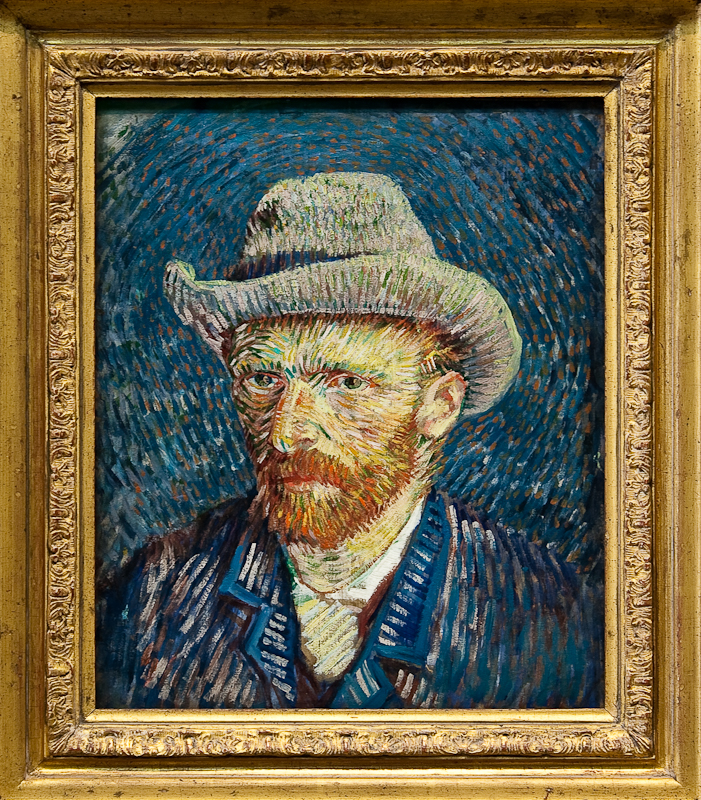
Looking at some of Vincent Van Gogh's self portraits, it can be difficult to impossible to tell what actual color his eyes were.  Just look at this self portrait from 1887 and your eyes will soon water from the strain. Some of his self-portraits hint that he had two different colored eyes.

It is also possible that Vincent himself did not know what color his eyes were.  He is thought to have experienced some color blindness.  He also had a habit of ignoring reality whenever it suited him.

My mother has blue eyes.  They are very apparently blue to me or just about anyone else that looks at her face.  However, she tells me that they look green.  My favorite singer Peter Gabriel, known for his soulful blue eyes, has sometimes told people that his eyes are actually green.

This got me thinking that Vincent may have seen his eyes in a way that no one else did. 

What is defiantly known is that he had ginger hair.  Men with ginger hair tend to have eyes that are blue. Artist A.S. Hartrick described Van Gogh's eyes as light blue.

Sunday, July 14, 2013

Did Drinking Absinthe Cause Van Gogh to Lose His Mind?

One of the allures to the story of Vincent Van Gogh is that this brilliant artist went crazy.  He didn't just go crazy -- he went bug-fucking nuts. Things he did included:

eating his paints
following women into their homes when he was clearly uninvited
pissing off anyone who could have helped his career
that cutting off his ear lobe thing


So Let's Try the Question Again

Why did Vincent Van Gogh become bug-fucking nuts? Because he died in 1890 (even before Sigmund Freud's publication of The Interpretation of Dreams for crying out loud) we really have no idea what spicy stew of mental and physical disorders that Vincent actually suffered from.  It was known that around the time of his death he suffered from:

  • syphilis
  • impotence
  • rotting teeth
  • hallucinations, which may have been caused by temporal lobe epilepsy
  • starvation due to extreme poverty
  • paranoia
  • alcoholism
Clearly, drinking absinthe was the least of Vincent's problems.

What About the Hallucinations?

One theory is that he hallucinated because he was addicted to absinthe.  The real absinthe was banned in France in 1915 but returned in 2012.  America's ban on real absinthe was lifted about 2007.  Until then, all anyone had to drink was weak substitutes.  Why was the stuff banned?  It was 110 to 144 proof.  I'm surprised Vincent lived as long as he did while quaffing this brew.  Rumor is that he drank it straight but absinthe was an expensive drink and so a bottle may have always been out of Vincent's price range.  It was usually drunk with lots of water and a melted sugar cube.

Absinthe has never been proven to cause hallucinations more than any other alcoholic beverage.  It could be that Vincent was especially sensitive to absinthe that it could have tipped him over the edge of sanity but Vincent was already teetering there.  Epilepsy and mental illness appeared frequently in Vincent's family.  Most of his siblings committed suicide.  His beloved brother Theo died insane and incontinent because of advanced syphilis. 

It wasn't just one factor that caused Vincent to go mad.  It was a large combination of factors.


Tuesday, July 9, 2013

YouTube Video: "The Yellow House" (2007) Channel 4 TV Movie

I lived just over five years in England and miss many things about it -- the great radio, the tea, the cheese and the telly.  Channel 4 is the edgier channel and often showed controversial documentaries.  I was living back in America when this one came out.  The Yellow House (2007) is a dramatization of a book by the same name.  It's not the most historically accurate film (according to the books about Vincent I've studied) but that's not the point.  The point was to highlight and contrast the conflicting personalities of Paul Gauguin and Vincent Van Gogh.

The film is about one hour and 13 minutes long and has incredibly good background music.  Pour a glass of your favorite wine (or tea, if you don't drink alcohol) and savor.  John Simm plays an excellent Vincent with John Lynch as the obnoxious and thoroughly self-absorbed Paul Gauguin.