The average person knows more about Vincent Van Gogh's life than about his artworks. Oh, they'll know about "The Starry Night" (because of the Don McLean song) and perhaps "Sunflowers" but not much else. Yet they'll know about the whole ear thing and that he killed himself and that he lived in dire poverty all of his artistic life and now his works sell for millions.
So, what is it about Van Gogh's story that attracts people? On the surface, it's a tragic story. Genius painter reviled and ignored winds up offing himself before his works sell for astronomical sums. You'd think people would be repelled by a story like that.
Just the opposite.
As you've probaby figured out, I'm no art critic and I'm no psychologist, sociologst or any other kind og "ist". I'm just a failed freelance writer who likes Vincent's artwork (and yes, I also like the Don McLean song.)
So, I can only tell you what I see in Vincent's sad story. I think this may be what others see in it, too. Feel free to tell me what you see in Vincent's story in the comments below.
I think Vincent knew that his artwork was special. He certainly had it in him to paint in a way that catered to popular tastes of the time. That's seen in early works done under the tutlage of Anton Mauve (and I like a lot of Mauve's stuff, too.) But he stubbornly took the road less traveled by (apologies to Robert Frost.) The stuff he painted was considered weird and ugly and common as muck.
During the last year or so of Vincent's life, he did start to receive some positive press. He clearly was not comfortable with any adulation. I think he'd gotten used to being a starving artist and worried that creature comforts could damage his artistic abilities. He know he was good and that's all he really cared about. He thought he knew best -- and turns out he was right. It's nice to be right.
I don't have any proof of this. That's mere conjecture on my part, based on studying Vincent's art and reading many books about him (both fiction and non.) It could be that Vincent was just plain crazy. Considering that he suffered from syphillis, it's not a wacky thought that he could not think straight for the last years of his life.
You do also have to wonder that he somehow knew that his art would be so successful after he died. His long-suffering family finally got their investment in him back in spades, so to speak, soon after he died and interest in his work began to soar. I think people who believe in an afterlife think that Vincent finally got to see all of his success after he was dead.
But me (who does not believe in any afterlife), I think Vincent knew he was right and that his art would eventually win over the world. And that's what people like about his story -- he didn't give up, even dying, becasue he knew he was right.
Wednesday, January 29, 2020
Monday, February 13, 2017
Two Stolen Van Goghs Now On Display in Italy
From the You Really Should Remember to Update Your Passport If You Want to See This Department:
In 2002 two priceless paintings by Vincent Van Gogh were nicked from the Van Gogh Museum. As time passed by, hopes of recovering the paintings dimmed. These are small paintings and so could be better hidden then say, a Diego Rivera mural. The paintings are "Seascape at Scheveningen" (1882) and "Congregation leaving the Reformed Church at Nuenen" (1884 or 1885.) (Pictured, left)
And then police in Napoli, Italy got news that a drug lord Raffaele Imperiale had them in his private collection. They raided the place and TA DA there were the paintings.
Before the paintings go back home to the Van Gogh Museum in Amsterdam, the museum is allowing a brief special (and heavily guarded) public showing in Naples. If you want to see them in Italy, act fast because the special display ends on February 26.
In 2002 two priceless paintings by Vincent Van Gogh were nicked from the Van Gogh Museum. As time passed by, hopes of recovering the paintings dimmed. These are small paintings and so could be better hidden then say, a Diego Rivera mural. The paintings are "Seascape at Scheveningen" (1882) and "Congregation leaving the Reformed Church at Nuenen" (1884 or 1885.) (Pictured, left)
And then police in Napoli, Italy got news that a drug lord Raffaele Imperiale had them in his private collection. They raided the place and TA DA there were the paintings.
Before the paintings go back home to the Van Gogh Museum in Amsterdam, the museum is allowing a brief special (and heavily guarded) public showing in Naples. If you want to see them in Italy, act fast because the special display ends on February 26.
Friday, February 3, 2017
The Philadelphia Museum of Art: A Review
Too much art for just one visit!
But if you actually go inside the building, you will have your breath taken away just as much as a foolish sprint up the steps.
More Than One Day's Worth
This writer's favorite painting in the world happens to reside in the Philadelphia Museum of Art. I would have missed it if I hadn't been lucky enough to have been born in raised in the greater Philadelphia area. The museum is incredibly vast. You cannot expect to "do" the Museum in just one day. That would not only do the works of art an injustice, but you will get a bad headache from the sensory overload and the stress of trying to see it all.
The best way to explore the museum is to have a map of it and then focusing on the art styles that most excite you. If you are going to the museum and don't live in the greater Philly area, then chances are you are coming for one of the magnificent exhibitions which often take place. The Philadelphia Museum of art is often the only East Coast choice for many priceless tours. If you are coming for a special exhibition, just go to the exhibition and don't worry about seeing anything else.
Famous Paintings
Although the Philadelphia Museum of Art is home to some of the world's most famous paintings, my favorite was painted by local boy Thomas Eakins. Even though I had been to the museum many times as a child, I somehow missed this massive painting, which is so realistic, it's almost a photograph. It's called Fairman Rogers Four In Hand (A May Morning in the Park).
Other famous paintings with a permanent home in Philadelphia are Eakins' more famous painting, "The Gross Clinic"; "Interior" by Edgar Degas (also known as "The Rape"); Duchamp's "Nude Descending a Staircase"; Monet's "Japanese Footbridge and Lily Pool"; Cezanne's "The Large Brothers"; Picasso's "Three Musicians" and the most famous version of Vincent Van Gogh's "Sunflowers" (my favorite Van Gogh.) The Impressionist Gallery alone is worth the admission price (which is about $20 but does not include admission to special exhibitions.)
Overwhelming
When you get overwhelmed by a painting and turn to walk away, you almost feel as if you have been shoved into a pool of icy water, because the real world comes at you like a shock. This is if you’re lucky enough to get an unobstructed view. The Philadelphia Museum of Art often draws huge crowds and throngs of schoolchildren – even on weekdays. Get used to dodging wheelchairs and weaving around toes.
Eventually, all of the art becomes a blur. At this point, head for the snack bar and try to get back to earth. It can be quite difficult to get out of the parking lot and then deal with Philly traffic, so you need to be able to concentrate.
Poem: Van Gogh
Painful
This way of seeing --
All the world
Thick with color, thin with time
Moving moving moving
The thoughts in the head in the eyes in the throat
Down down down
On the surface of forever
Vincent van GoghPainting, Oil on Canvas on Triplex Board
Paris: Winter, 1887 - 88
Saturday, December 26, 2015
Best of Van Gogh Birthday Celebrations
In case you didn't know it, 2015 is the 162nd birthday year of our man Vincent. There were many great and not-so-great celebrations of this sobering passage of time this year, but here are the best. And how did I judge them to be the best? Entirely from my biased viewpoint, of course! If you know of any other celebrations worth noting, feel free to leave info or links in the comments section.
Here we go now:
Commemorative Coin
I guess it only made "cents" that a coin would be made to celebrate Vincent. In this case, the amount is 5 Euros and 10 Euros, a denomination that did not exist during all of Vincent's short life. Actually, I cheated a little to include this on the list. The coins came out years ago, but I just found about them this year SO THERE.
Minneapolis Institute of Art's Honkin' Big Recreation of "Olive Trees"
Going to fly into the Minneapolis Airport anytime soon? Or perhaps you recently had a flight and looked out the window and thought you were losing what was left of your mind? Well, you will or may have already checked out the massive recreation of Van Gogh's Olive Trees in a field near the airport. The work was commissioned by the Minneapolis Institute of Art (MIA) and done by "earthworks artist" Stan Herd. No, I don't know what Stan heard, but it looks like you can dance to it. Wow!
Starry Night Grown in a Petri Dish
Now, scientists get a bad rap by those of an artistic employment. But scientists are highly creative individuals, as shown by members of the American Society for Microbiology. Van Gogh's big birthday coincided nicely with the first art contest put on by the society. The canvas was a petri dish (or succession of them) and the paint were different colored strains of bacteria. Now that's taking art to new levels and to new species.
The Google Doodle
Because they had to. (This originally went up in 2005.)
And a special shout out to
The Dahlia Parade in Zundert, Netherlands
In September, there was a flower parade to end all flower parades -- for Van Gogh fans, anyway. Floats a mere 62 feet long celebrating Van Gogh's works. Floats took about a year to make and were mostly made up of 50 species of dahlia flowers. The Rose Bowl got nuthin' on this. Well done, Zundert. More photos can be found here.
Here we go now:
Commemorative Coin
I guess it only made "cents" that a coin would be made to celebrate Vincent. In this case, the amount is 5 Euros and 10 Euros, a denomination that did not exist during all of Vincent's short life. Actually, I cheated a little to include this on the list. The coins came out years ago, but I just found about them this year SO THERE.
Minneapolis Institute of Art's Honkin' Big Recreation of "Olive Trees"
Going to fly into the Minneapolis Airport anytime soon? Or perhaps you recently had a flight and looked out the window and thought you were losing what was left of your mind? Well, you will or may have already checked out the massive recreation of Van Gogh's Olive Trees in a field near the airport. The work was commissioned by the Minneapolis Institute of Art (MIA) and done by "earthworks artist" Stan Herd. No, I don't know what Stan heard, but it looks like you can dance to it. Wow!
Starry Night Grown in a Petri Dish
Now, scientists get a bad rap by those of an artistic employment. But scientists are highly creative individuals, as shown by members of the American Society for Microbiology. Van Gogh's big birthday coincided nicely with the first art contest put on by the society. The canvas was a petri dish (or succession of them) and the paint were different colored strains of bacteria. Now that's taking art to new levels and to new species.
The Google Doodle
Because they had to. (This originally went up in 2005.)
And a special shout out to
The Dahlia Parade in Zundert, Netherlands
In September, there was a flower parade to end all flower parades -- for Van Gogh fans, anyway. Floats a mere 62 feet long celebrating Van Gogh's works. Floats took about a year to make and were mostly made up of 50 species of dahlia flowers. The Rose Bowl got nuthin' on this. Well done, Zundert. More photos can be found here.
Thursday, May 14, 2015
Van Gogh in Poetry
Vincent Van Gogh is not just a great artist (oh no) but he is also considered a great metaphor for poets. (For those of you who failed English 101, a metaphor is a description that does not use "like" or "as.") In other words, metaphors are things used to describe other things. This may seem like a roundabout way of making a point, but many times the point made with a metaphor makes more of an impact than if a poet or writer just used a plain description.
Here's a short look at how Vincent Van Gogh has been used to describe other things by major poets of the twentieth century. Major to ME, anyway and hopefully major to you. This is in no way a comprehensive list.
Charles Bukowski
This much-missed American icon (and subject of the cult film Barfly) was one of the most accessible poets America ever produced. He made his point without being sappy or using references so obscure that only he himself could comprehend them. Van Gogh shows up several times in the course of Bukowski's career.
Van Gogh is the starving artist who no one understands. He's very much like Bukowski himself, only Bukowski did receive critical acclaim and some money in his debauched lifetime. Van Gogh is described as a romantic and a professional fighter. He's also sometimes a hero for Bukowski, such as in "About My Very Tortured Friend Peter."
Anne Sexton
Anne Sexton was the OTHER woman poet who committed suicide. She's best remembered, perhaps, as the inspiration for Peter Gabriel's classic song Mercy Street. She was also a very powerful and influential poet who first wrote poetry as a suggestion from her therapist. She wrote mostly about herself.
The Starry Night refers to Van Gogh's painting of the same name (the one Dan Mclean sang about.) It begins with a quote from Van Gogh's letters. It then describes Sexton's emotions when viewing the painting. It has an achingly beautiful refrain: "Oh starry starry night! This is how I want to die." You're not alone, there Anne.
The Van Gogh Poetry Challenge
While researching this article, I stumbled across the Van Gogh poetry challenge. It has some interesting work. Poetry and paintings both are stereo-typically hard to get for the average person, but I think these poems are easy to get and rewarding to read.
If you could write a poem about Van Gogh, what would you write?
Here's a short look at how Vincent Van Gogh has been used to describe other things by major poets of the twentieth century. Major to ME, anyway and hopefully major to you. This is in no way a comprehensive list.
Charles Bukowski
This much-missed American icon (and subject of the cult film Barfly) was one of the most accessible poets America ever produced. He made his point without being sappy or using references so obscure that only he himself could comprehend them. Van Gogh shows up several times in the course of Bukowski's career.
Van Gogh is the starving artist who no one understands. He's very much like Bukowski himself, only Bukowski did receive critical acclaim and some money in his debauched lifetime. Van Gogh is described as a romantic and a professional fighter. He's also sometimes a hero for Bukowski, such as in "About My Very Tortured Friend Peter."
Anne Sexton
Anne Sexton was the OTHER woman poet who committed suicide. She's best remembered, perhaps, as the inspiration for Peter Gabriel's classic song Mercy Street. She was also a very powerful and influential poet who first wrote poetry as a suggestion from her therapist. She wrote mostly about herself.
The Starry Night refers to Van Gogh's painting of the same name (the one Dan Mclean sang about.) It begins with a quote from Van Gogh's letters. It then describes Sexton's emotions when viewing the painting. It has an achingly beautiful refrain: "Oh starry starry night! This is how I want to die." You're not alone, there Anne.
The Van Gogh Poetry Challenge
While researching this article, I stumbled across the Van Gogh poetry challenge. It has some interesting work. Poetry and paintings both are stereo-typically hard to get for the average person, but I think these poems are easy to get and rewarding to read.
If you could write a poem about Van Gogh, what would you write?
Friday, March 20, 2015
"The Yellow House: Van Gogh, Gauguin, and Nine Turbulent Weeks in Arles", By Martin Gayford: A Review
(This review first appeared at Goodreads. That's where I've been spending a shameful amount of time instead of updating this blog. ANYWAY --)
There was a telemovie made in the UK in 2007 based on this book by Martin Gayford (Little, Brown & Company). For once, the movie wound up being much better than the book. This book promises more than it can deliver. Just what happened between Paul Gauguin and Vincent Van Gogh remains just as mysterious as before reading this convoluted book. Although it is generously illustrated, none are in color -- a great handicap for two artists who were so devoted to color.
There are much better books about Van Gogh out there than "The Yellow House."
I was also disappointed at how much this book spent on Gaugain's life after the Yellow House. The book could have been better if it focused on the time of the Yellow House and only mentioned what happened to Gauguin briefly. The author apparently had very little material to work with and decided to milk it for what it was worth.
There was a telemovie made in the UK in 2007 based on this book by Martin Gayford (Little, Brown & Company). For once, the movie wound up being much better than the book. This book promises more than it can deliver. Just what happened between Paul Gauguin and Vincent Van Gogh remains just as mysterious as before reading this convoluted book. Although it is generously illustrated, none are in color -- a great handicap for two artists who were so devoted to color.
There are much better books about Van Gogh out there than "The Yellow House."
I was also disappointed at how much this book spent on Gaugain's life after the Yellow House. The book could have been better if it focused on the time of the Yellow House and only mentioned what happened to Gauguin briefly. The author apparently had very little material to work with and decided to milk it for what it was worth.
Sunday, November 23, 2014
"Van Gogh's Women"; By Derek Fell: A Review
There are a lot of Vincent Van Gogh biographies out there. Derek Fell's 2004 effort Van Gogh's Women: His Love Affairs and Journey into Madness is one of the best because it centers on one main aspect of Vincent's life -- how he got on with women. It starts off with Vincent's relationship (or lack thereof) with his mother. He also points out that being born on the same day as his stillborn older brother -- and sharing the exact same name as the dead baby -- really messed Vincent up before he had a chance to mess himself up.
For some reason, Vincent's relationship with Paul Gauguin is also included in great detail. I wasn't entirely sure why, as Fell notes that the two bohemian artists did not have a homosexual relationship (although they shared at least one whore between them.) I also did not care about reading so much about the creepy Gauguin when I wanted to read about Vincent.
This book also pushes the theory that Dr. Paul Gachet (Vincent's last doctor) helped kill Vincent. I'm not entirely sold on that theory, but it sure is interesting to read about.
The hardback edition I borrowed from the library had many reproductions of Vincent's works and photos of Vincent's family. Again, Gauguin intrudes into the limited space the publishers made available for illustrations. (Big sigh.) Still, I highly recommend the book.
For some reason, Vincent's relationship with Paul Gauguin is also included in great detail. I wasn't entirely sure why, as Fell notes that the two bohemian artists did not have a homosexual relationship (although they shared at least one whore between them.) I also did not care about reading so much about the creepy Gauguin when I wanted to read about Vincent.
This book also pushes the theory that Dr. Paul Gachet (Vincent's last doctor) helped kill Vincent. I'm not entirely sold on that theory, but it sure is interesting to read about.
The hardback edition I borrowed from the library had many reproductions of Vincent's works and photos of Vincent's family. Again, Gauguin intrudes into the limited space the publishers made available for illustrations. (Big sigh.) Still, I highly recommend the book.
Friday, October 17, 2014
Van Gogh Painting At Sotheby's May Make $50 Million
Have an extra $50 million burning a hole in your pocket? That's how much you'll need to get one of the Venus' arms of paintings, a Van Gogh looking for a buyer. Prestigious auction house Sotheby's is estimates that Still Life, Vase with Daisies and Poppies (1890) (also called Still Life: Red Poppies and Daisies) will go under the hammer anywhere from $30 million to $50 million (US).
The painting officially goes on sale November 4 at Sotheby's Impressionist and Modern Art Evening Sale. It is, unpredictably, predicted to be the sale highlight. Museums, private owners of Van Gogh's works and the companies that insure them will be more than eager to see what the final price is as this will help them re-evaluate how much their Van Gogh's are now worth.
What's so special about this painting? It's red flowers in a vase, right? The background is similar to those of the infamous Sunflowers series. This also may be one of the last paintings that Van Gogh did, according to the New York Observer. It was painted at Auvers-sur-Oise, France, possibly in June of 1890.
Let's hope that Still Life, Vase with Daisies and Poppies does not share the same fate as Portrait of Dr. Gachet which disappeared after being bought at a Christie's auction for a Japanese collector 1990. That painting's price was over $82 million. Very few Van Gogh paintings have ever been on the open market in America since the 1980's, notes The Financial Times.
Image is from the Van Gogh Gallery's excellent website.
EDIT November 5: The painting went for $61.8 million.
The painting officially goes on sale November 4 at Sotheby's Impressionist and Modern Art Evening Sale. It is, unpredictably, predicted to be the sale highlight. Museums, private owners of Van Gogh's works and the companies that insure them will be more than eager to see what the final price is as this will help them re-evaluate how much their Van Gogh's are now worth.
What's so special about this painting? It's red flowers in a vase, right? The background is similar to those of the infamous Sunflowers series. This also may be one of the last paintings that Van Gogh did, according to the New York Observer. It was painted at Auvers-sur-Oise, France, possibly in June of 1890.
Let's hope that Still Life, Vase with Daisies and Poppies does not share the same fate as Portrait of Dr. Gachet which disappeared after being bought at a Christie's auction for a Japanese collector 1990. That painting's price was over $82 million. Very few Van Gogh paintings have ever been on the open market in America since the 1980's, notes The Financial Times.
Image is from the Van Gogh Gallery's excellent website.
EDIT November 5: The painting went for $61.8 million.
Friday, October 10, 2014
Vincent Van Gogh The Musical -- Just Say No
The passion of the artist committed to finding the sacred in the common ... the suffering of an ignored genius ... the ultimate tragedy of an artist dying on the verge of international acclaim ... all of this is just a fraction of the complex portrait of the man, the myth, the legend -- Vincent Van Gogh.
And soon it will coming to you -- as a musical.
WHAT? No, sorry -- you read that right. According to the Telegraph, Vincent will premier in Amsterdam sometime in the autumn of 2015. Why 2015? Because that is the 125th anniversary of Van Gogh's death. It will be produced by a Dutchman, Albert Verlinde. The aim of the musical is to "bring Vincent van Gogh's works to life in a non-traditional way". Content is expected to focus on the decent into madness and the Ear Thing.
Non-traditional is right. Amsterdam -- you have been warned.
The Don McClean pop song was bad enough (hey -- at least that was catchy if way too fanboyish). Do we really have to suffer through a two-hour musical? Or even just the knowledge that a musical on Van Gogh exists? Only if it's a comedy, please.
The rather bemused and confused Van Gogh Museum of Amsterdam plans on holding a special exhibit that somehow has a tenuous connection with the musical. The director of the museum has been quoted in the press as saying, "It's perhaps a little odd to celebrate his death."
Just when you think pop culture can't get any worse -- it does.
And soon it will coming to you -- as a musical.
WHAT? No, sorry -- you read that right. According to the Telegraph, Vincent will premier in Amsterdam sometime in the autumn of 2015. Why 2015? Because that is the 125th anniversary of Van Gogh's death. It will be produced by a Dutchman, Albert Verlinde. The aim of the musical is to "bring Vincent van Gogh's works to life in a non-traditional way". Content is expected to focus on the decent into madness and the Ear Thing.
Non-traditional is right. Amsterdam -- you have been warned.
The Don McClean pop song was bad enough (hey -- at least that was catchy if way too fanboyish). Do we really have to suffer through a two-hour musical? Or even just the knowledge that a musical on Van Gogh exists? Only if it's a comedy, please.
The rather bemused and confused Van Gogh Museum of Amsterdam plans on holding a special exhibit that somehow has a tenuous connection with the musical. The director of the museum has been quoted in the press as saying, "It's perhaps a little odd to celebrate his death."
Just when you think pop culture can't get any worse -- it does.
Friday, July 4, 2014
An Overview of Van Gogh's Relationships
Vincent Van Gogh (1853 - 1890) painted people with remarkable sympathy but failed to get along with people in real life. He was deemed a failure by most of his family, had no lifelong friends and never married. In his entire short life, he had just one trusted confidant - his younger brother Theo. Theo was so attached to Vincent that he died a mere six months after his older brother.
Van Gogh's Family
Vincent was the oldest son of five children. He was born about one year after his mother gave birth to a still born son named Vincent. His father was a pastor, but more importantly his Uncle Vincent worked as a successful art dealer for the French firm Goupil & Cie. Vincent originally was going to follow his uncle's footsteps and sell art as opposed to creating it. He even worked in Guopil & Cie.'s London branch for two years.
Vincent did not receive any support from his large family with the sole exception of his brother Theo. Most of Vincent's letters to Theo survived and have been published. Vincent was considered bizarre and a misfit by his other family members. Vincent tried to woo his widowed cousin but she refused him. This caused a huge rift in the family that already was pushing Vincent away.
Van Gogh's Lovers
Although the legend claims that Vincent cut his ear off as a present for his favorite whore, this legend has been debunked. But Vincent did go to prostitutes. No "decent" woman would have anything to do with him. Modern doctors state that Vincent's bizarre behavior may have been the result of a combination of mental illness and a chronic ailment such as epilepsy or migraines.
Vincent moved to The Hague in 1881. In 1882, he met a pregnant prostitute, Clasina Maria Hoornik, and fell in love with her. They lived together, which caused a major scandal. The relationship was doomed from the start, but Vincent's tenderness towards his lover shows in his drawings of her, including the much loved Sorrow.
Van Gogh's Contemporaries
Most other artists would not have anything to do with Vincent, since his poverty made him have poor grooming habits and his ailments made his behavior unpredictable. He did briefly study under Anton Mauve, then a famous Dutch realistic painter. But Mauve soon tired of his scandalous student and soon would have nothing to do with him.
The only artist to attempt to collaborate with Vincent was yet another social misfit, Paul Gauguin. They briefly shared lodgings at Arles, France but often fought. Both were alcoholics and both were impoverished. Some biographers claim it was Gauguin who cut off part of Vincent's ear.
Additional References
Van Gogh.Rene Huyghe. Crown Publishers; 1967.
Dear Theo: The Autobiography of Vincent Van Gogh. Irving Stone & Jean Stone, editors. Plume; 1995.
Van Gogh's Family
Vincent was the oldest son of five children. He was born about one year after his mother gave birth to a still born son named Vincent. His father was a pastor, but more importantly his Uncle Vincent worked as a successful art dealer for the French firm Goupil & Cie. Vincent originally was going to follow his uncle's footsteps and sell art as opposed to creating it. He even worked in Guopil & Cie.'s London branch for two years.
Vincent did not receive any support from his large family with the sole exception of his brother Theo. Most of Vincent's letters to Theo survived and have been published. Vincent was considered bizarre and a misfit by his other family members. Vincent tried to woo his widowed cousin but she refused him. This caused a huge rift in the family that already was pushing Vincent away.
Van Gogh's Lovers
Although the legend claims that Vincent cut his ear off as a present for his favorite whore, this legend has been debunked. But Vincent did go to prostitutes. No "decent" woman would have anything to do with him. Modern doctors state that Vincent's bizarre behavior may have been the result of a combination of mental illness and a chronic ailment such as epilepsy or migraines.
Vincent moved to The Hague in 1881. In 1882, he met a pregnant prostitute, Clasina Maria Hoornik, and fell in love with her. They lived together, which caused a major scandal. The relationship was doomed from the start, but Vincent's tenderness towards his lover shows in his drawings of her, including the much loved Sorrow.
Van Gogh's Contemporaries
Most other artists would not have anything to do with Vincent, since his poverty made him have poor grooming habits and his ailments made his behavior unpredictable. He did briefly study under Anton Mauve, then a famous Dutch realistic painter. But Mauve soon tired of his scandalous student and soon would have nothing to do with him.
The only artist to attempt to collaborate with Vincent was yet another social misfit, Paul Gauguin. They briefly shared lodgings at Arles, France but often fought. Both were alcoholics and both were impoverished. Some biographers claim it was Gauguin who cut off part of Vincent's ear.
Additional References
Van Gogh.Rene Huyghe. Crown Publishers; 1967.
Dear Theo: The Autobiography of Vincent Van Gogh. Irving Stone & Jean Stone, editors. Plume; 1995.
Thursday, June 26, 2014
Van Gogh's Ear Regrown: WTF?
I was first hoping that this was an Internet joke, but apparently it's not: some modern German artist has claimed to have re-grown the infamous ear of Vincent Van Gogh. The Van Gogh DNA is supposedly from the back of an envelope Van Gogh was thought to have licked and from the saliva of a direct descendent of Theo Van Gogh, Lieuwe Van Gogh. It was then put into a computer program for three years and ABRACADABRA a 3-D printed image of Van Gogh's unmutilated ear was born.
Okay, I'm sure the actual process was a wee bit more complicated, but STILL, that's about what happened.
The 3-D ear was then placed in a spiffy box so that viewers can whisper their secrets into Vincent's ear -- which looks more like a creepy Jell-o mold than an ear. The piece is still not finished. It's still growing in a funky bubbly solution while it is on display in ZKM Karlsruhe Museum. In 2015, the piece is to be displayed somewhere in New York (where it may get an interesting headline in the New York Post but then be ignored.)
Anyway, the piece is called Sugarbabe (why not something that can be easily remembered, like Van Gogh's Ear? Trying to be ironic? Or just being a pain in the arse?) CNN gave this "news" the best treatment with this title "Apparently This Matters: Vincent Van Gogh's 3-D printed ear."
The artist, who's name I don't feel like mentioning, told the press that ear is alive: "Absolutely it’s alive!” she says. “What we did is create a machine to mimic the body. The whole system in which the ear lives you could say is the skin. The nutrition comes from the plasma. We have a pump, which is the heart, and an oxygen exchange like a lung.”
Wait -- WHAT? Did I miss something? Since when have ears been given personhood status?
I think even Vincent would have been fatally embarrassed by this one.
Okay, I'm sure the actual process was a wee bit more complicated, but STILL, that's about what happened.
The 3-D ear was then placed in a spiffy box so that viewers can whisper their secrets into Vincent's ear -- which looks more like a creepy Jell-o mold than an ear. The piece is still not finished. It's still growing in a funky bubbly solution while it is on display in ZKM Karlsruhe Museum. In 2015, the piece is to be displayed somewhere in New York (where it may get an interesting headline in the New York Post but then be ignored.)
Anyway, the piece is called Sugarbabe (why not something that can be easily remembered, like Van Gogh's Ear? Trying to be ironic? Or just being a pain in the arse?) CNN gave this "news" the best treatment with this title "Apparently This Matters: Vincent Van Gogh's 3-D printed ear."
The artist, who's name I don't feel like mentioning, told the press that ear is alive: "Absolutely it’s alive!” she says. “What we did is create a machine to mimic the body. The whole system in which the ear lives you could say is the skin. The nutrition comes from the plasma. We have a pump, which is the heart, and an oxygen exchange like a lung.”
Wait -- WHAT? Did I miss something? Since when have ears been given personhood status?
I think even Vincent would have been fatally embarrassed by this one.
"Leaving Van Gogh"; By Carol Wallace: A Review
If you liked Lust for Life (1934) by Irving Stone, then you are going to be really disappointed with Carol Wallace's Leaving Van Gogh (2011.) Stone did the historical novel thing so much better and with far more intensity and focus than Wallace's rather sloppy word-portrait of both Vincent Van Gogh and his last therapist, Dr. Paul Gachet (yes -- the same Dr.Gachet of the infamous portraits.)
A far more interesting book would have been speculation on whatever happened to the painting Portrait of Dr. Gachet (1890), which disappeared in 1990 after being bought by a really rich Japanese guy.
The novel is told from Dr. Gachet's point of view. Granted, Dr. Gachet is one of the more mysterious characters on the fringe of art history. He was not only a bad amateur artist and spectacular art collector, he also treated Impressionists like Renoir. He clearly made a big impression on Van Gogh, which is why he did the portrait in the way he did.
The plot is all over the place. Dr. Gachet goes into flashbacks into most inconvenient times, which really interrupts the narrative. The big revelation of the novel turns out to be no revelation at all. Dr. Gachet sees Van Gogh in rose-tinted spectacles, which really clashes with the historical portrait we have of him. YES, I know this is work of fiction, but HONESTLY!
A far more interesting book would have been speculation on whatever happened to the painting Portrait of Dr. Gachet (1890), which disappeared in 1990 after being bought by a really rich Japanese guy.
The novel is told from Dr. Gachet's point of view. Granted, Dr. Gachet is one of the more mysterious characters on the fringe of art history. He was not only a bad amateur artist and spectacular art collector, he also treated Impressionists like Renoir. He clearly made a big impression on Van Gogh, which is why he did the portrait in the way he did.
The plot is all over the place. Dr. Gachet goes into flashbacks into most inconvenient times, which really interrupts the narrative. The big revelation of the novel turns out to be no revelation at all. Dr. Gachet sees Van Gogh in rose-tinted spectacles, which really clashes with the historical portrait we have of him. YES, I know this is work of fiction, but HONESTLY!
Sunday, April 13, 2014
YouTube Video: "Simon Schama's The Power of Art: Vincent Van Gogh"
This 2006 documentary is one episode of an eight-part series where historian Simon Schama takes a look at famous painters and how they impacted art and society. There is also a book to accompany this series. This is beautifully shot with some gorgeous footage of where Van Gogh lived. I gets a bit Painted With Words at times, but is well worth the time. This is not a comprehensive documentary of his life (the whole ear thing is barely mentioned) but concentrates on how why he painted as he did.
Although I recommend this program, here are a couple of warnings:
- There's swearing
- Van Gogh is pronounced wrong
- There is a disturbing scene of Vincent eating a tube of yellow paint
- There's Simon Schama himself, who takes a little getting used to. He has a peculiar voice and a very drone-like way of speaking. However, he does have a droll sense of humor and has a great sense of why Van Gogh matters.
My Favorite Van Gogh Painting: Sunflowers
I've just realized that I've had this blog for over a year and have yet to write extensively about my favorite painting by Vincent Van Gogh. I will now rectify this immediately.
As this post's title suggests, my favorite Van Gogh painting is Sunflowers (Tournesols). Ah, but which Sunflowers, you ask? Van Gogh did numerous paintings featuring these gaudy flowers in different shades, vases and sometimes with other flowers. The one I like is the most famous version with a yellow-gold background, painted in 1888 and now hangs in the National Gallery in London.
Why? Well, my Mom bought a cheap framed reproduction when I was a very small child. It hung on the stairway next to the stacks of National Geographics that my family once collected (and are now long gone.) About 40 years later, after my parents' divorce, my two busted live-in relationships and God knows how many moves, it's about all that's left of my childhood. It's still owned by my Mom.
When I was 29, I had a mental breakdown and ran away to live with a busker in England. That didn't work out and I burned a lot of bridges back to America. And then one day my make-shift shelter in the woods was burnt down. The fire brigade suspected arson. I knew someone was trying to kill me and my dog. I never thought my Mom would take me in, but she did -- and took my dog in, too.
She set up a bedroom for me in the basement. There, propped against a mirror, was the Sunflowers painting. I had come home.
Below is a short news clip about two of the most famous versions from London and the Van Gogh Museum in Amsterdam of Sunflowers being shown side by side.
What is your favorite Van Gogh painting?
As this post's title suggests, my favorite Van Gogh painting is Sunflowers (Tournesols). Ah, but which Sunflowers, you ask? Van Gogh did numerous paintings featuring these gaudy flowers in different shades, vases and sometimes with other flowers. The one I like is the most famous version with a yellow-gold background, painted in 1888 and now hangs in the National Gallery in London.
Why? Well, my Mom bought a cheap framed reproduction when I was a very small child. It hung on the stairway next to the stacks of National Geographics that my family once collected (and are now long gone.) About 40 years later, after my parents' divorce, my two busted live-in relationships and God knows how many moves, it's about all that's left of my childhood. It's still owned by my Mom.
When I was 29, I had a mental breakdown and ran away to live with a busker in England. That didn't work out and I burned a lot of bridges back to America. And then one day my make-shift shelter in the woods was burnt down. The fire brigade suspected arson. I knew someone was trying to kill me and my dog. I never thought my Mom would take me in, but she did -- and took my dog in, too.
She set up a bedroom for me in the basement. There, propped against a mirror, was the Sunflowers painting. I had come home.
Below is a short news clip about two of the most famous versions from London and the Van Gogh Museum in Amsterdam of Sunflowers being shown side by side.
What is your favorite Van Gogh painting?
Wednesday, April 9, 2014
Orangutan Being Called the Next Van Gogh
Let me clear. I have nothing against orangutans. I like orangutans. But I have a real hard time taking seriously anyone who compares an orangutan's paintings to a Van Gogh. That's what ABC News is saying on their website.
Rudi Valentino, the 36 year old male orangutan lives at the Houston Zoo. It must be kinda dull at the zoo, because 10 years ago, Rudi took up a new hobby -- painting. He paints on any surface he can get a hold of. Van Gogh's painting career only lasted ten years.
According to Rudi's keepers, his favorite color is pink and that he has "an artistic temperament."
Rudi's works are being auctioned off tomorrow, April 10, in order to benefit the zoo. Rudi's not the only animal artist in the auction. There are also works by an elephant, a clouded leopard and a pig. I have seen some of Rudi's work (pictured) and I have to say I'm not impressed. Sure, he still paints better than I do, but he's not quite in the Van Gogh department.
If Rudi is supposedly like Van Gogh, then his keepers need to keep him away from booze and whores is all I'm saying.
Rudi Valentino, the 36 year old male orangutan lives at the Houston Zoo. It must be kinda dull at the zoo, because 10 years ago, Rudi took up a new hobby -- painting. He paints on any surface he can get a hold of. Van Gogh's painting career only lasted ten years.
According to Rudi's keepers, his favorite color is pink and that he has "an artistic temperament."
Rudi's works are being auctioned off tomorrow, April 10, in order to benefit the zoo. Rudi's not the only animal artist in the auction. There are also works by an elephant, a clouded leopard and a pig. I have seen some of Rudi's work (pictured) and I have to say I'm not impressed. Sure, he still paints better than I do, but he's not quite in the Van Gogh department.
If Rudi is supposedly like Van Gogh, then his keepers need to keep him away from booze and whores is all I'm saying.
Wednesday, April 2, 2014
Scientists Use Van Gogh Paintings to Look at History of Climate
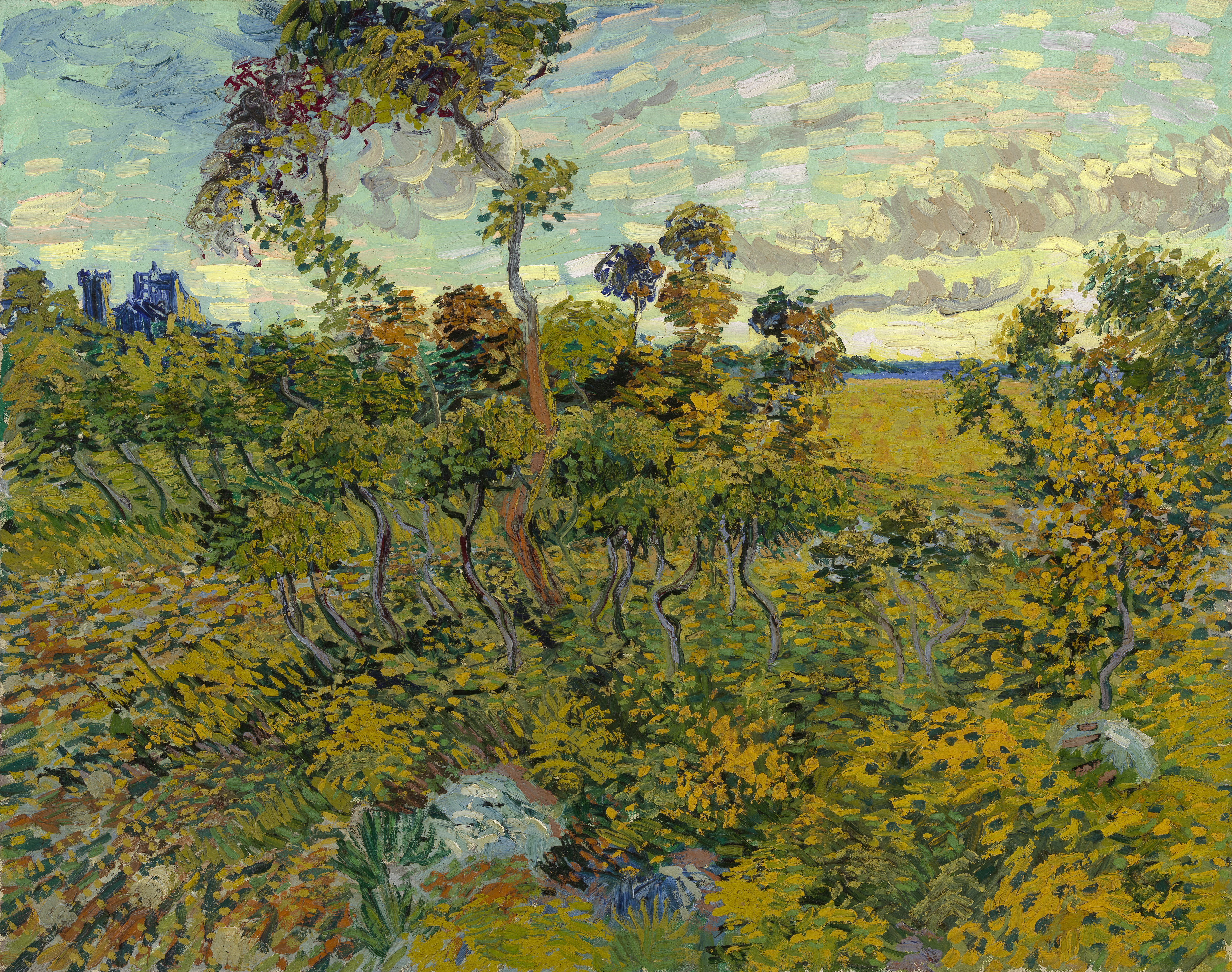
Vincent Van Gogh doesn't just matter to art lovers, but also to scientists. Some Greek and German scientists have looked at hundreds of paintings and photos from 1500, including Van Gogh's recently discovered Sunset at Montmajour (pictured) in order to see what the skies used to look like. Their article was published in the journal Atmospheric Chemistry and Physics.
Why bother looking at paintings? Well, they didn't have photographs (let alone color photographs) back in 1500. One subject painters seemed to love was how the sky looked like after a volcanic explosion. By comparing the paintings to color photographs of polluted skies and skies after volcanic explosions, scientists hope to get a better picture of our planet's climactic history.
This isn't the first time this group has used paintings to help figure out the history of the air. They previously published a large study in the same journal back in 2007. They also commissioned a contemporary artist to paint sunsets after a dust storm in 2010 on the island of Hydra. Paintings by JMW Turner were also used in the study.
According to the study's authors, "Because of the large number of paintings studied, we tentatively propose the conclusion that regardless of the school, red-to-green ratios from great masters can provide independent proxy AODs [Aerosol Optical Depth] that correlate with widely accepted proxies and with independent measurements."
Why bother looking at paintings? Well, they didn't have photographs (let alone color photographs) back in 1500. One subject painters seemed to love was how the sky looked like after a volcanic explosion. By comparing the paintings to color photographs of polluted skies and skies after volcanic explosions, scientists hope to get a better picture of our planet's climactic history.
This isn't the first time this group has used paintings to help figure out the history of the air. They previously published a large study in the same journal back in 2007. They also commissioned a contemporary artist to paint sunsets after a dust storm in 2010 on the island of Hydra. Paintings by JMW Turner were also used in the study.
According to the study's authors, "Because of the large number of paintings studied, we tentatively propose the conclusion that regardless of the school, red-to-green ratios from great masters can provide independent proxy AODs [Aerosol Optical Depth] that correlate with widely accepted proxies and with independent measurements."
Tuesday, March 4, 2014
Van Gogh, 4 Other Artists Immortalized in Food in Art Fund Competition
Let me begin by saying that I used to be homeless. Food was a sacred issue. To find any was rapture and to waste any was an unforgivable sin. You could play with your food -- but only if nothing was wasted and everything was eaten before it began to rot.
So forgive me if I cannot get into the food art fad, which got a huge shot of publicity in February when the prestigious Time magazine did a feature on 5 artistic masterpieces recreated with food, including Vincent Van Gogh's Self Portrait with a Bandaged Ear turned into a vertical ploughman's lunch (pictured, left.) The frame is made up of sliced bead and French loaf, the eyes peppercorns, the coat button a pickle slice, the green bits lettuce and the bandage a smear of brie. Somewhere there are gherkins, pickled onions and yellow cheese.
Another interesting creation was a Rice Crispie Treat splattered with icing to mimic a Jackson Pollack painting. Also there is a recreation of Damien Hurst's Skull which defies explanation, although apparently almonds played a part in it. See even more on Art Fund's Instagram page, Facebook page or on Twitter using the #ediblemasterpieces.
These creations were done to raise money for the UK non-profit Art Fund as part of the Edible Masterpieces Project, a competition which goes in until 30 June, 2014. This uses all kinds of fundraising events to give money to UK's art galleries and museums so they will not close. Now that I can sink my teeth into.
Image is from Slate, which got it from Art Fund. I'm not sure if the image is copyrighted. (Sorry!)
So forgive me if I cannot get into the food art fad, which got a huge shot of publicity in February when the prestigious Time magazine did a feature on 5 artistic masterpieces recreated with food, including Vincent Van Gogh's Self Portrait with a Bandaged Ear turned into a vertical ploughman's lunch (pictured, left.) The frame is made up of sliced bead and French loaf, the eyes peppercorns, the coat button a pickle slice, the green bits lettuce and the bandage a smear of brie. Somewhere there are gherkins, pickled onions and yellow cheese.
Another interesting creation was a Rice Crispie Treat splattered with icing to mimic a Jackson Pollack painting. Also there is a recreation of Damien Hurst's Skull which defies explanation, although apparently almonds played a part in it. See even more on Art Fund's Instagram page, Facebook page or on Twitter using the #ediblemasterpieces.
These creations were done to raise money for the UK non-profit Art Fund as part of the Edible Masterpieces Project, a competition which goes in until 30 June, 2014. This uses all kinds of fundraising events to give money to UK's art galleries and museums so they will not close. Now that I can sink my teeth into.
Image is from Slate, which got it from Art Fund. I'm not sure if the image is copyrighted. (Sorry!)
"Van Gogh: The Life" By Steven Naifeh and Gregory White Smith; The Review
I meant to write a review of Van Gogh: The Life by Steven Naifeh and Gregory White Smith ages ago but couldn't because I still haven't finished the book. Why haven't I? It's over 1000 pages long in itty-bitty print. It's the only time I was glad Vincent Van Gogh died at age 37 or who knows how long this monster would've turned out. Quite frankly, my life is too short to spend months reading just one damn book.
The Good
This is unquestionably the most thorough and best researched biography ever written of Van Gogh's entire life and legend. It also made headlines around the world back when it was first published in 2011 for it's theory that someone else shot Van Gogh instead of Van Gogh. Naifeh and Smith claim that two teenage boys that liked to bully Van Gogh accidentally shot the tormented artist. Van Gogh did not want them to get into trouble, so he told everyone that he shot himself. At that point I his life, Van Gogh was looking forward to death. It's a convincing argument, I have to admit.
The Bad
There are a couple hundred pages of notes. The notes are in even smaller print than the text or captions. Now, granted, most people ignore the notes, but I'm one of those people who does not. Perhaps I can blame Richard Dawkins for his very entertaining notes for that, but there you are. Hi -- my name is Rena Sherwood and I am a note reader. However, it's impossible to read the notes and match it up with the text because there are no note numbers in the text. You have to read the book and then the notes or keep flipping to the chapter notes after reading a chapter. No thanks.
The Downright Ugly
If Van Gogh is your hero, get ready to have your illusions completely shattered. Van Gogh may have been an artistic genius, but he had a boatload of problems. He would self-sabotage himself so much so that you can start predicting how he will lose friends and make powerful enemies before it happens. Van Gogh's paranoia and intensity makes his letters hard to interpret. He would constantly mention a great new friend in one letter and then never mention that person again, except to trash talk him or her. In some ways, you wish you could go back in time just to smack Van Gogh across the face and yell, "SNAP OUT OF IT!"
The Good
This is unquestionably the most thorough and best researched biography ever written of Van Gogh's entire life and legend. It also made headlines around the world back when it was first published in 2011 for it's theory that someone else shot Van Gogh instead of Van Gogh. Naifeh and Smith claim that two teenage boys that liked to bully Van Gogh accidentally shot the tormented artist. Van Gogh did not want them to get into trouble, so he told everyone that he shot himself. At that point I his life, Van Gogh was looking forward to death. It's a convincing argument, I have to admit.
The Bad
There are a couple hundred pages of notes. The notes are in even smaller print than the text or captions. Now, granted, most people ignore the notes, but I'm one of those people who does not. Perhaps I can blame Richard Dawkins for his very entertaining notes for that, but there you are. Hi -- my name is Rena Sherwood and I am a note reader. However, it's impossible to read the notes and match it up with the text because there are no note numbers in the text. You have to read the book and then the notes or keep flipping to the chapter notes after reading a chapter. No thanks.
The Downright Ugly
If Van Gogh is your hero, get ready to have your illusions completely shattered. Van Gogh may have been an artistic genius, but he had a boatload of problems. He would self-sabotage himself so much so that you can start predicting how he will lose friends and make powerful enemies before it happens. Van Gogh's paranoia and intensity makes his letters hard to interpret. He would constantly mention a great new friend in one letter and then never mention that person again, except to trash talk him or her. In some ways, you wish you could go back in time just to smack Van Gogh across the face and yell, "SNAP OUT OF IT!"
Wednesday, February 19, 2014
Little Seen Van Gogh Painting Fetches 16.9 Million Pounds at Auction
A Sotheby's auction in early February reached a record amount in part due to a Van Gogh painting which fetched 16.9 million pounds, reports Bloomberg. The Van Gogh was the second most expensive painting of the London auction, which raked in a grand total of 169.5 million pounds (US $266.8 million.)
The first most expensive painting of the evening was "Boulevard Montmartre" by Camille Pissarro. It was estimated to go at 10 million pounds but when the hammer fell the price was 19 million pounds. About 60% of the auction pieces went for prices higher than Sotheby's estimate, which indicates that the world art market is coming back strong.
Van Gogh's "The Man Is At Sea (L’Homme Est en Mer)" was estimated to bring in a mere 8 million pounds. This is the canvas' second time at Sotheby's. In 1989, it was sold in the New York branch of Sotheby's for a piddling $7.15 million. Things get a little muddied as to the painting's history after 1989. According to Sotheby's, it was bought by an anonymous art consigner in 1993 and sold to Holocaust survivor and art dealer Jan Krugier. Krugier died in 2008 but his extensive art collection did not go on sale until this year.
Van Gogh painted the woman and baby at home waiting for Daddy in front of the hearth while he was an inmate at the asylum in Saint-Remy, France in 1889, about a year before the artist's death. Van Gogh's paintings were considered worthless in his lifetime. The first owner of the painting was Dr. Paul Gachet, Vincent's final therapist and one of his models. It has had several wealthy owners after the good doctor's family sold the painting in the early 1900s. It was last exhibited publicly in Paris in 1905.
The first most expensive painting of the evening was "Boulevard Montmartre" by Camille Pissarro. It was estimated to go at 10 million pounds but when the hammer fell the price was 19 million pounds. About 60% of the auction pieces went for prices higher than Sotheby's estimate, which indicates that the world art market is coming back strong.
Van Gogh's "The Man Is At Sea (L’Homme Est en Mer)" was estimated to bring in a mere 8 million pounds. This is the canvas' second time at Sotheby's. In 1989, it was sold in the New York branch of Sotheby's for a piddling $7.15 million. Things get a little muddied as to the painting's history after 1989. According to Sotheby's, it was bought by an anonymous art consigner in 1993 and sold to Holocaust survivor and art dealer Jan Krugier. Krugier died in 2008 but his extensive art collection did not go on sale until this year.
Van Gogh painted the woman and baby at home waiting for Daddy in front of the hearth while he was an inmate at the asylum in Saint-Remy, France in 1889, about a year before the artist's death. Van Gogh's paintings were considered worthless in his lifetime. The first owner of the painting was Dr. Paul Gachet, Vincent's final therapist and one of his models. It has had several wealthy owners after the good doctor's family sold the painting in the early 1900s. It was last exhibited publicly in Paris in 1905.
Subscribe to:
Comments (Atom)
.jpg)
.jpg)